
The studio that creates your CGI owns the copyright by default, even after you’ve paid the invoice in full. If you need to reuse, adapt, or resell those images beyond a narrow marketing brief, you must negotiate a written assignment or an exclusive, perpetual licence that names your territory, duration, and media. Without that clause, and without agreed access to source files, you’re relying on goodwill rather than a right.
TL;DR:
- Licences should specify territory, duration, media, adaptation rights, and sublicensing to avoid misunderstandings and ensure valid reuse of CGI images.
- Source files and editable assets are crucial for future modifications, and requesting them in precise formats prevents costly recreations.
- Using AI-assisted tools or third-party assets requires confirmation of licensing clearance and warranties to mitigate infringement risks.
- Including clear rights clauses, deliverables, warranties, and escrow agreements in contracts helps prevent disputes over copyright and usage rights.
- Paying for full rights or perpetual licences is advisable for large projects or ongoing marketing, while limited licences suit short-term campaigns.
Table of Contents
- What is CGI image licensing and who owns commissioned renders?
- How do you define licence scope: territory, duration, and media?
- Why do source files and editable assets matter?
- What risks come from third-party assets and AI-generated content?
- What clauses and red flags should a CGI contract checklist include?
- When should you pay for full rights versus a limited licence?
- Get a rights-aware quote for your next CGI project
- Sources
What is CGI image licensing and who owns commissioned renders?
Under UK copyright law, the person or studio that creates a work owns the copyright in it unless a contract states otherwise. This applies to commissioned architectural CGI exactly as it applies to a photograph or a piece of music. Gov is unambiguous on this point: paying for the work does not transfer ownership. That single fact catches out more property professionals than any other clause in a CGI brief.
This is where cgi image licensing becomes the operative term. Rather than owning the artwork outright, most commissioners are granted a licence, a permission to use the images within agreed limits, while the studio retains the underlying copyright. Understanding the distinctions between the main legal instruments matters more than most briefs suggest:
- Assignment: full transfer of copyright to you, the commissioner. You become the legal owner, able to use, adapt, or sell the images without reference back to the studio.
- Exclusive licence: you get sole rights to use the images for agreed purposes, even the studio can’t licence them to anyone else, but copyright itself stays with the creator.
- Non-exclusive licence: you can use the images as agreed, but the studio remains free to licence the same or similar assets elsewhere.
- Implied licence: no written terms at all. A court infers what use was “reasonably intended” from the circumstances, which is inherently unpredictable.
An implied licence is the riskiest position for a property developer or agent to be in. Sprintlaw’s guidance for UK businesses hiring freelancers makes clear that vague or absent terms leave both sides guessing about what happens when a scheme is sold on, a marketing campaign is extended, or you switch to a different visualisation supplier. Case law on architects’ drawings shows this isn’t theoretical. Disputes over image rights have surfaced specifically around site sales and ownership transfers where copyright wasn’t properly documented at the outset.
How do you define licence scope: territory, duration, and media?
A licence that just says “marketing use” is close to worthless in a dispute. You need to specify five dimensions before you sign anything, and each one carries real commercial weight.
- Territory: decide whether you need UK-only rights, a specific region, or global coverage. A local estate agency rarely needs worldwide rights; an international investor pitch deck usually does.
- Duration: a limited term (say, two or three years covering a sales campaign) costs less than perpetual rights, but you’ll need to renegotiate or repurchase if the development is still marketing after the term expires.
- Media: name every channel explicitly. Web, property portals, print brochures, outdoor advertising, investor packs, and planning submissions are not interchangeable, and a licence silent on one of them may not cover it.
- Adaptation rights: confirm whether you can alter the images, composite them into other materials, animate a still render, or extract individual 3D elements for reuse in a different context.
- Sublicensing: if you expect to sell the site, bring in a joint venture partner, or hand marketing to a third-party agency, the licence needs to say explicitly whether those parties can use the images too.
Pro Tip: Ask for the licence scope in writing before the studio starts modelling, not after delivery. Renegotiating usage terms once images exist gives the studio far more leverage, and you far less room to walk away.
Sprintlaw’s freelancer IP guidance notes that clients needing future reuse or adaptation rights should secure this in the licence from the outset rather than assuming broad use was implied by the original brief.
Why do source files and editable assets matter?
Final renders (JPEG, TIFF, or MP4 for animations) are the finished product. Source files, native 3D scene files, CAD or BIM exports, layered PSDs, are the working materials that let anyone regenerate or modify the imagery later. Most studios deliver only the former unless you ask for the latter, and that distinction has real consequences down the line.
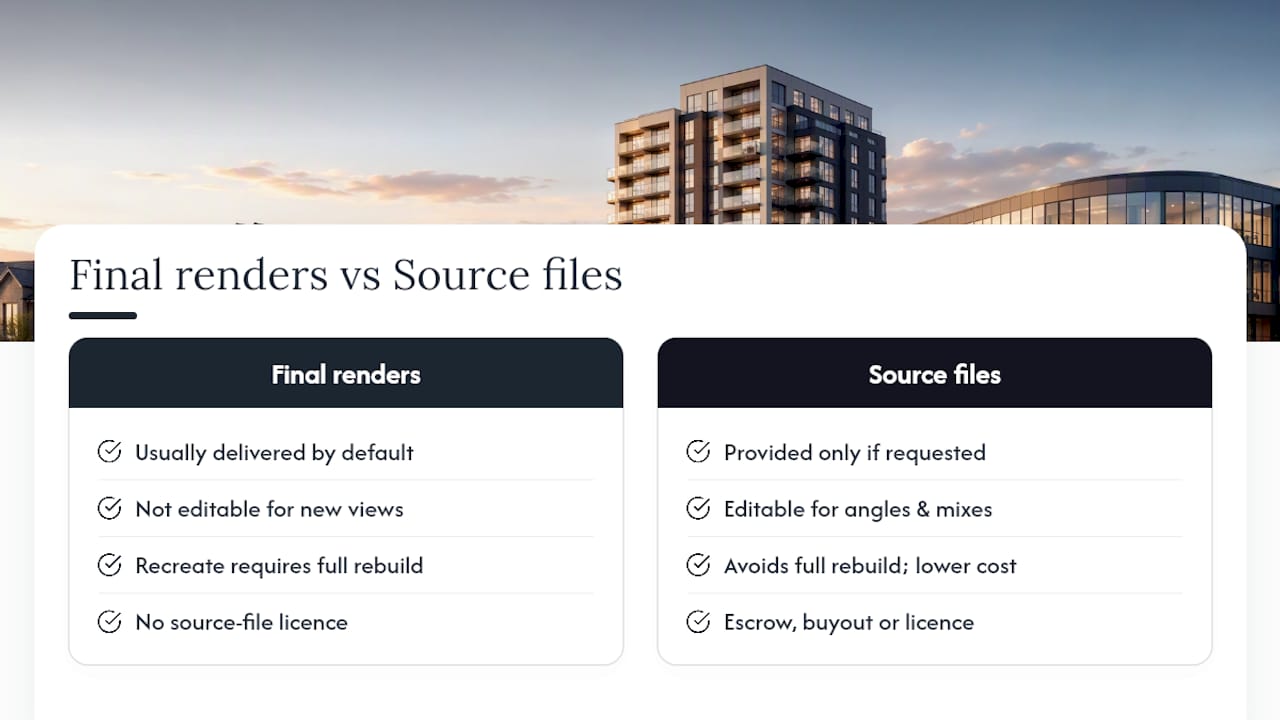
You’ll want source files if you anticipate new camera angles, a change in unit mix, a future refurbishment, or a switch to a different visualisation partner. Without them, recreating even a slightly different view often means starting from scratch, and paying again.
Phrase your delivery requirements precisely: exact file formats, accompanying documentation, and a clear statement of rights for any third-party assets embedded in the scene (textures, plugins, furniture libraries). Where studios are reluctant to hand over full source files, workable compromises include staged escrow arrangements, a paid source-file buyout at project close, or a limited-use licence covering source files for internal edits only.
What risks come from third-party assets and AI-generated content?
CGI studios routinely build scenes using licensed stock textures, HDRIs for lighting, and increasingly, AI-assisted tools for elements like foliage, skies, or staging furniture. Each of those components carries its own licence terms, and if the studio’s licence for a texture or plugin doesn’t cover your intended commercial use, that gap becomes your problem, not theirs.
AI tools compound this. RIBA Journal’s reporting on AI use in architecture highlights growing concern among practitioners that AI-generated content complicates authorship and raises imitation risk, since the training data behind these tools is rarely transparent. Before signing off a brief, ask your studio to confirm:
- Whether any AI-assisted tools were used in producing the final images.
- Written warranties that all third-party elements are cleared for your specific commercial use, not just general portfolio display.
- A source list or provenance note for any AI-generated components.
- An indemnity, where commercially reasonable, covering breaches of third-party rights.
Practitioner surveys referenced by RIBA show active, growing use of generative AI tools across architectural practice, alongside real unease about how that use affects copyright certainty. If a studio can’t clear a particular asset, ask for alternative imagery rather than accepting the risk.
What clauses and red flags should a CGI contract checklist include?
Most CGI disputes trace back to the same handful of missing clauses. Building these into your brief or appointment letter from the start avoids the awkward renegotiation that happens after delivery.
- Rights clause: state explicitly whether you require assignment or a licence, and if a licence, its territory, duration, media, and adaptation terms.
- Deliverables schedule: list every format, resolution, and file type expected, including whether source files are included, and when each is due.
- Warranties and indemnities: the studio should warrant it has authority to licence or assign the work, including any third-party or AI-assisted elements, per the guidance on consultant appointments under the CDPA.
- Payment triggers tied to rights transfer: link final payment to the point rights actually transfer, not just to delivery of files.
- Escrow or staged handover: for source files, agree a mechanism (paid buyout, staged release, or escrow) rather than leaving it open-ended.
Pro Tip: Watch for vague phrases like “usage rights included” with no further detail. That single line has caused more post-project disputes than almost any other clause in a CGI brief, because it defines nothing.
Other red flags: a studio that won’t confirm third-party clearances in writing, or one that insists on an absolute ban on any future editing of the images. Legal guidance on consultant appointments also stresses handling moral rights, and any waiver of them, clearly within the contract rather than leaving it implied.
When should you pay for full rights versus a limited licence?
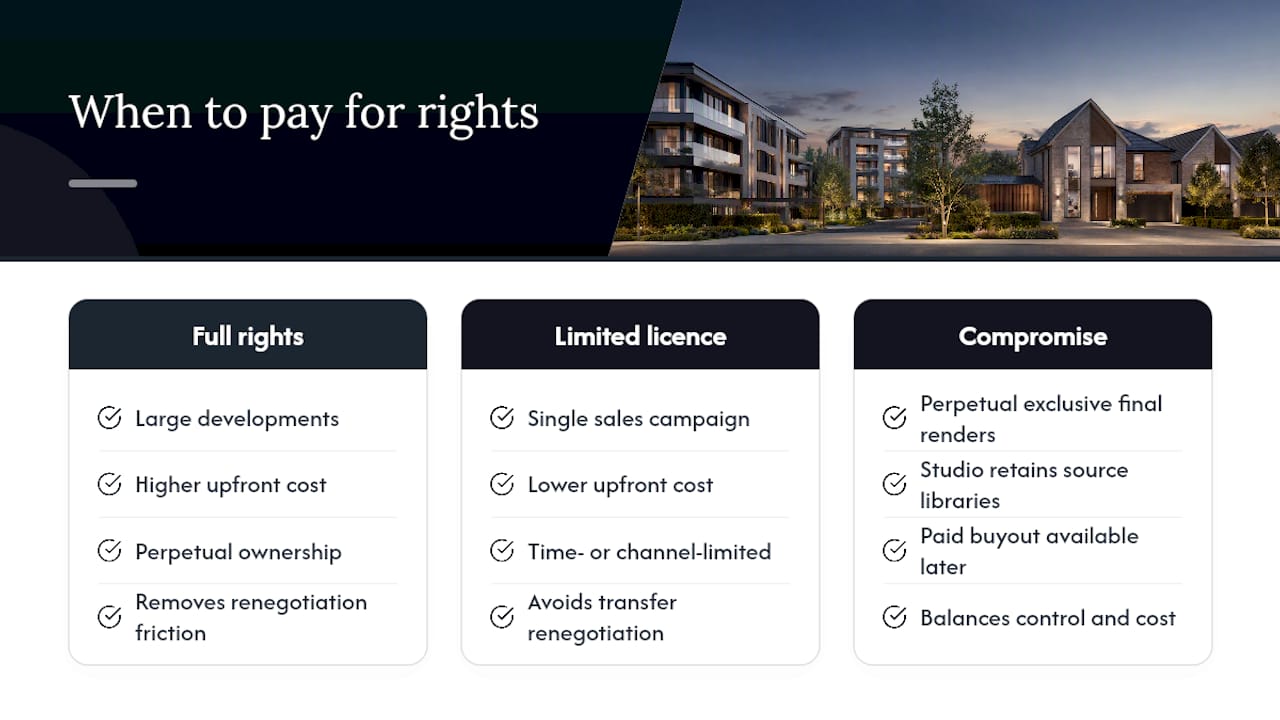
Paying for full assignment or a perpetual licence makes sense on large developments, sites likely to be sold or transferred to a new owner, or portfolios you’ll market for years. The upfront cost is higher, but it removes the recurring friction of renegotiating rights every time a campaign extends or a buyer’s solicitor asks awkward questions about who actually owns the marketing imagery.
For a single sales campaign with a defined end date, a time-limited or channel-limited licence is usually the commercially sensible choice. One practical compromise, common across the industry, grants the client a perpetual, exclusive licence for final renders while the studio retains its source libraries, with a paid buyout available if you later need full source-file control.
— Paride
Get a rights-aware quote for your next CGI project
Visualtrick builds licensing into the brief from day one, not as an afterthought once renders are finished. Every project comes with clearly documented rights, whether that’s a licence scoped to your marketing campaign or a broader assignment for developments you expect to hold, sell, or expand over several years.
Packages typically include planning-ready CGI and photomontage with licence terms confirmed in writing before work begins, plus an optional source-file buyout for clients who anticipate future refurbishments, unit changes, or a switch in supplier down the line. If you’re commissioning imagery for a planning submission, an off-plan sales campaign, or an investor pack, get in touch through Visualtrick’s architectural visualisation service page to discuss the rights package that fits your project, or explore 3D rendering services for a detailed proposal tailored to your development.
Sources
- Gov
- IP ownership when hiring freelancers – Sprintlaw UK
- Copyright in the age of AI – RIBA Journal / RIBAJ
- Copyright in a consultant’s appointment under the CDPA 1988 – LexisNexis UK
