
Commission verified aerial photomontage and a short flythrough first: these two outputs carry the most weight with planning committees and community audiences alike. Add high-quality exterior stills for marketing and press, and an interactive viewer once the design is stable enough for public consultation. Everything else, from floor plans to night renders, sits downstream of that core set. The commissioning checklist further down will help you brief a supplier against exactly this shortlist.
TL;DR:
- Verified aerial photomontages are the most trusted CG outputs for planning committees because they accurately place proposals within real photographic contexts.
- Short flythrough videos effectively demonstrate pedestrian movement and public space use, which static images alone cannot convey convincingly to stakeholders.
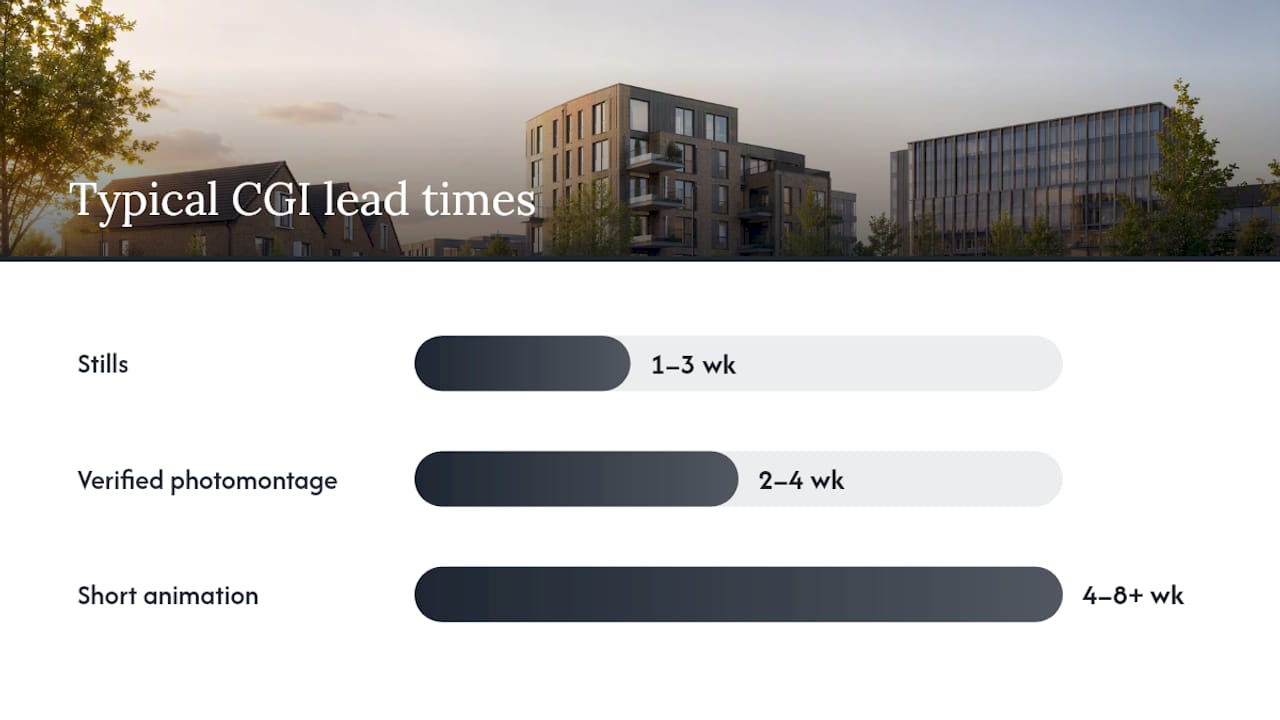
- Production times vary from one to three weeks for stills, two to four weeks for verified views, and four to eight weeks for animations, depending on complexity and review iterations.
- Cost is driven by the number of viewpoints, detail level, and whether surveyed control points or accurate georeferencing are required, with verified views incurring higher expenses.
- Focusing on a small set of well-chosen visual assets—such as one verified aerial photomontage and a short flythrough—often determines project success more than volume of images.
Table of Contents
- What CGI outputs do regeneration schemes actually need?
- Why does CGI matter for planning, consultation and funding?
- How does a regeneration CGI project actually get made?
- What drives the cost of regeneration CGI, and what should a brief include?
- How has CGI supported a real regeneration planning process?
- Choosing realism, speed or interactivity: where should budget go?
- How Visual Trick supports regeneration commissions
- Sources
- FAQ
What CGI outputs do regeneration schemes actually need?
Every regeneration scheme needs a different mix of visuals depending on its audience and stage, but a handful of formats do most of the work.
- Exterior stills show façade materials, street level detailing and how a building meets the pavement. They are the workhorse image for design review and early marketing.
- Aerial photomontage and verified views place the proposed massing into an existing photograph, taken from an agreed viewpoint. Planning officers rely on these because they tie the design directly to a real, verifiable context rather than an artist’s impression.
- 3D animation or flythrough sequences movement through a site: pedestrian routes, phasing, how a public square fills up over the day. This is where regeneration projects show change over time, not just a single frozen view.
- Interactive 360 or VR tours let a councillor or resident explore a scheme at their own pace, which is difficult to replicate with a fixed image.
- Ancillary assets, including 2D and 3D floor plans, material detail crops, and day/night variants, round out a brief and answer the smaller questions a single hero image cannot.
A studio producing exterior visuals and video walk-throughs for a mixed-use regeneration scheme typically pairs those two formats precisely because static images and moving sequences answer different questions for different audiences.
Why does CGI matter for planning, consultation and funding?
Planning drawings and technical elevations are accurate, but they are not persuasive. Most people, including some planning committee members, cannot translate a section drawing into a felt sense of scale. CGI closes that gap.
- Reduces ambiguity in submissions by showing exactly how a proposal reads against the existing streetscape.
- Helps non-technical stakeholders judge massing, height and how public realm changes will actually feel to walk through.
- Gives investors and funders a narrative asset that a spreadsheet or a phasing plan cannot provide on its own.
- Matches format to audience: councillors tend to respond to verified photomontage tied to a fixed viewpoint, community groups respond to flythroughs and interactive tours, and investors want a polished still or short cinematic sequence.
Pro Tip: Aerial photomontage and verified views remain the most trusted deliverable for planning committees because they anchor a proposed design to a real photographic context rather than an idealised drawing.
Local authorities already lean on this format publicly. Council communications teams regularly release CGI flythroughs to explain regeneration proposals to residents ahead of formal consultation, and short, well paced sequences tend to land better with the public than long cinematic pieces built for spectacle rather than clarity.
How does a regeneration CGI project actually get made?
The production workflow for regeneration CGI follows a fairly consistent path, though the length of each stage depends on scheme complexity and how much existing data you can supply.
- Briefing. Define audience, output formats, viewpoints and deadline against planning committee dates or consultation events.
- Site capture. Photography, drone footage and topographic survey data are gathered to ground the model in reality.
- Model import and context build. CAD or BIM files are brought into the render engine and the surrounding streetscape, trees and neighbouring buildings are modelled or sourced.
- Concept visuals. Early draft renders confirm camera angles, lighting and material direction before full detail work begins.
- Review iterations. Client and planning consultant feedback rounds refine massing, materials and context accuracy.
- Final outputs. Verified stills, photomontage and animation are rendered, colour graded and delivered in the agreed file formats.
Suppliers need CAD or BIM files, topographic survey data, verified site photography, material palettes and any planning constraints (conservation area boundaries, listed building sightlines) up front. Skipping this stage is the single biggest cause of delay.
Typical lead times run one to three weeks for stills, two to four weeks for verified photomontage, and four to eight weeks or more for a short animation, depending on scene complexity and the number of review rounds. Schemes with heavy vegetation, complex phasing, or multiple verified viewpoints take longer. Verified views require accurate georeferencing against survey control points, so build in time for a site survey if one does not already exist, and expect your supplier to work through datum points and photo reprojection before final sign off.
What drives the cost of regeneration CGI, and what should a brief include?
Cost scales with the number of views, the level of modelling detail, whether the supplier has to build the surrounding context from scratch, and how long and complex any animation needs to be. Verified views that must meet planning authority accuracy standards typically add cost, because they demand surveyed control points and a more rigorous quality process than a marketing-only render.
Most studios price per image, per minute of animation, or as a package covering several deliverables across project phases. Retainer arrangements suit developers running long regeneration programmes with recurring visual needs across planning, marketing and sales.
A commissioning brief that gets you a comparable, accurate quote should include:
- The exact number and location of viewpoints, ideally marked on a site plan.
- Whether verified accuracy is required, and for which specific views.
- Available source files: CAD, BIM, topographic survey, photography.
- Target audience for each asset (planning committee, community consultation, investors).
- Required file formats and resolution for print, web and presentation use.
- Deadline against a fixed external date, such as a committee meeting or public event.
How has CGI supported a real regeneration planning process?
A recurring pattern across regeneration projects that reach planning committee successfully is a small, focused set of deliverables rather than a large, unfocused batch of images.
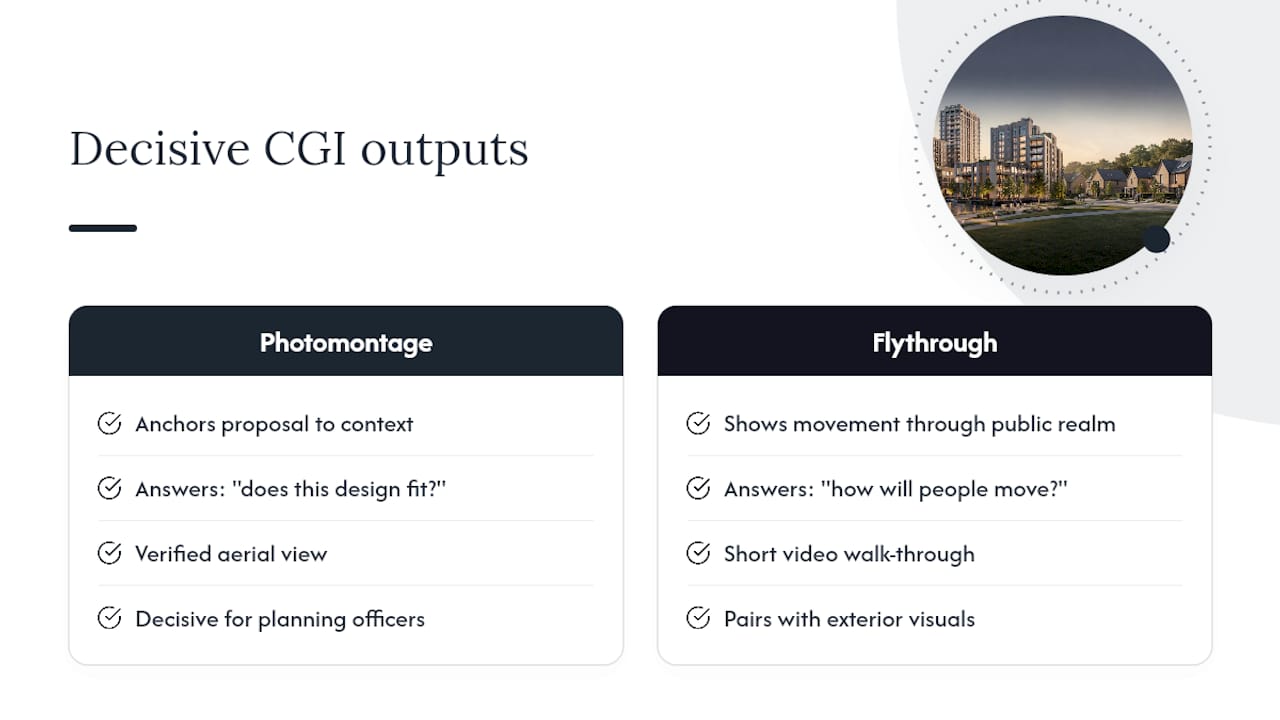
The combination that tends to decide outcomes is not volume of imagery. It is one verified aerial photomontage that anchors the proposal to its real context, paired with a short flythrough that shows how people will actually move through the finished public realm.
Verified aerial photomontage tends to prove decisive because it answers the planning officer’s core question directly: does this design fit where it sits? A short flythrough then answers the second question, showing pedestrian routes and public space, which stills alone cannot demonstrate. Studios producing this type of work for mixed-use schemes with retail and residential elements consistently pair exterior visuals with a video walk-through rather than relying on either format in isolation.
Visual Trick works from that same principle, offering planning visuals, verified views and aerial photomontage alongside animation and interactive tours, so developers and planning consultants can commission the specific mix a scheme actually needs rather than a generic package.
Choosing realism, speed or interactivity: where should budget go?
Photorealism earns its cost when a scheme faces scrutiny from a planning committee or a sceptical community group who need to trust what they are looking at. Schematic or diagrammatic visuals work perfectly well for early massing studies, where the point is spatial logic, not finish.
Interactive viewers add real value during consultation events, letting residents explore a scheme themselves rather than watching a fixed sequence, but they need budget set aside to keep them updated as the design evolves. Emerging AI-assisted rendering workflows, of the kind used in projects that train models on curated image archives, are worth watching but still need human oversight to avoid stylistic drift from the actual approved design.
The most efficient developers structure their brief so a verified viewpoint and a base 3D model can be reused across planning, marketing and investor materials, rather than commissioning each phase from scratch.
— Paride
How Visual Trick supports regeneration commissions
Visual Trick works as an in-house studio rather than a brokered agency, so you deal with the person actually building your model, not an account manager relaying messages. That matters most on regeneration schemes, where committee dates do not move and a missed review cycle can cost weeks. The relevant services here are planning visuals and verified views, 3D animation, architectural visualisation for exterior context, and virtual tours for consultation events.
To get an accurate quote quickly, send over your CAD or BIM files, any topographic survey you already hold, your target viewpoints, and the committee or event date you are working towards. Request a quote through the services page and Visual Trick will confirm which outputs and lead time fit your scheme.
Sources
The regeneration project pages and studio examples below informed the workflow and format guidance above.
- REGENERATION OF A MIXED-USE SCHEME | CGI DESIGN – CGconnect: Explore. Inspire. Grow.
- CATK x Bauhaus Dessau – Regenerate Response
FAQ
What is CGI rendering?
CGI rendering is the process of generating a realistic 2D image, animation or interactive scene from a 3D digital model, using lighting, materials and camera settings to make a proposed building or scheme look photographic.
What does regeneration mean in housing and planning terms?
Regeneration refers to the redevelopment or renewal of an area, typically involving new or improved housing, public realm and infrastructure, aimed at reversing decline in a town centre, estate or district.
What are the biggest regeneration projects in London?
London’s major regeneration schemes include large-scale mixed-use redevelopments across areas such as Nine Elms, Old Oak Common and various borough-led town centre renewal programmes, most of which rely on aerial photomontage and animation during planning consultation.
What are some major regeneration projects in the UK outside London?
UK regeneration activity extends well beyond the capital, with town centre and waterfront schemes underway in cities including Manchester, Birmingham and Oldham, where councils have publicly released CGI flythroughs to explain proposals to residents.
How much does regeneration CGI typically cost?
Cost depends on the number of views, modelling complexity and whether verified accuracy is required, so pricing varies by project; Visual Trick’s current rates are available on request through its services page.
