
High-quality property CGI can deliver measurable ROI when it is tracked properly, but many developers do not link enquiries back to the visuals that generated them. The verdict: treat CGI as a trackable marketing asset, not a design nicety. Start by adding UTM tags to every campaign touchpoint and making sure your CRM captures the source of each enquiry against the sale it eventually produces.
TL;DR:
- ROI tracking must start before campaign launch, as CGI production often takes several weeks and early enquiry data is more indicative of success.
- View-to-enquiry and enquiry-to-sale conversion rates are key metrics, with faster reservation times indicating stronger ROI from CGI visuals.
- Proper attribution requires UTM tagging, dedicated landing pages, and CRM linkage to trace enquiry sources through to sales accurately.
- High-quality, outcome-focused briefs and strategic reuse of assets across channels maximize the impact and cost-efficiency of CGI investments.
- Simple experiments like A/B testing a CGI versus non-CGI listing page can validate the visual’s effect within weeks, guiding larger rollout decisions.
Table of Contents
- Why measuring property CGI ROI matters for sales, marketing and planning
- Key metrics and KPIs to track the impact of property CGI
- How to measure ROI: practical tools, attribution and experiment methods
- How to maximise ROI from your CGI investment
- First-hand proof points from Visual Trick
- A simple measurement plan to try on the next project
- Put a measurable CGI strategy into action with Visual Trick
- Sources
- FAQ
Why measuring property CGI ROI matters for sales, marketing and planning
CGI does three jobs at once: it sells concepts to planners, persuades buyers before a single brick is laid, and gives sales teams a tool that shortens the gap between enquiry and reservation. High-quality visuals help planners, equity partners and buyers understand a scheme’s fit within its surroundings, which speeds up both planning consent and pre-sales.
The risk is treating CGI as a one-off production cost rather than a performance asset. Without measurement, a developer has no way of knowing whether a £3,000 hero exterior render earned its keep or simply sat on a listing page doing nothing.
Budget and timing both affect when returns actually show up:
- Production lead time for a full CGI package typically runs several weeks, so ROI tracking needs to start before launch, not after.
- Off-plan campaigns often see the bulk of enquiries in the first six to eight weeks, meaning early data matters more than end-of-campaign totals.
- Planning-stage visuals pay back on a different timeline entirely: their value shows in reduced objections and faster committee decisions, not immediate sales.
Key metrics and KPIs to track the impact of property CGI
Measuring ROI on property CGI comes down to five metric groups, each answering a different question about performance.
- View to enquiry rate. Divide unique visitors to a CGI-led page by the enquiries it generates. A hero exterior render on a strong landing page is generally expected to outperform a generic gallery image; if it doesn’t, the asset or the page may need revisiting.
- Enquiry to sale conversion. Track what proportion of CGI-sourced enquiries convert to reservations, and compare that against enquiries from other channels. This is the single number that tells you whether the visuals are attracting serious buyers or just curious clicks.
- Off-plan sales velocity. Count reservations per marketing period and measure time to reservation from first enquiry. Faster time to reservation on CGI-heavy campaigns is one of the clearest signals the visuals are doing commercial work.
- Engagement metrics. For interactive assets like 360 tours or short animations, dwell time and completion rate show whether buyers are actually engaging or bouncing after a few seconds.
- Marketing efficiency. Cost per enquiry, incremental revenue attributed to CGI-led campaigns, and a basic ROI formula: (revenue attributed to CGI minus CGI production and distribution cost) divided by that cost.
Historical company-level ROI figures, such as those tracked for large corporations, are useful only as background on how return metrics work in general. Long-run corporate ROI data reflects entire business performance, not marketing asset performance, so don’t use it as a project benchmark.
Statistic to watch: visual content generates significantly more engagement than text alone, which is why the view-to-enquiry metric usually moves first and fastest once CGI replaces flat floor plans or stock photography on a listing page.
Planning-stage KPIs work differently. Track committee decision speed, number of objections raised, and whether planning officers request fewer revisions when verified views and photomontages are submitted alongside the application.
How to measure ROI: practical tools, attribution and experiment methods
Getting reliable numbers starts with a minimum tracking setup, and most developers skip at least one piece of it.
- Tag every campaign, email, and social post with UTM parameters so traffic sources are visible in analytics.
- Build a dedicated landing page for each major CGI asset rather than dropping renders into a generic gallery.
- Set up event tracking on interactive assets (tour starts, completions, animation plays) so engagement isn’t a guess.
- Capture the enquiry source field in your CRM at the point of contact, not retrospectively.
- Tie that source field through to the final sale or reservation record, so every deal has a traceable origin.
Combining UTM tagging with CRM linkage and a single attribution setup is usually enough to prove incremental impact without building a full multi-touch model. Save complex attribution modelling for larger portfolios running several concurrent campaigns, where a simple last-touch view starts to misrepresent which channel actually closed the deal.
For validating whether CGI specifically moved the needle, run an A/B test: launch two versions of a listing page, one with CGI hero imagery and one without, and compare conversion over a matched period. A control group of similar units marketed without upgraded visuals gives you a cleaner read than guessing at industry averages.
Pro Tip: Run your first A/B test on a single phase or unit type rather than the whole development. A smaller, cleaner test gives you a usable answer in weeks, not months, and de-risks the bigger rollout.
The practical stack is straightforward: an analytics platform for traffic and events, a CRM for source-to-sale linkage, and your ad platform’s native reporting for cost-per-enquiry by channel. None of this needs enterprise software, it just needs someone accountable for keeping the fields filled in.
How to maximise ROI from your CGI investment
The brief you give a studio determines the return more than almost anything else. Ask for specific viewpoints tied to funnel stages, not just “make it look nice.”
- Brief for outcomes, not aesthetics. Specify which viewpoint supports the planning submission, which supports the hero marketing image, and which needs a clear call-to-action baked into the composition.
- Prioritise the deliverables that actually drive reservations. A strong hero exterior, two or three key interior views, and one interactive asset (a 360 tour or a short animation) tend to move enquiries more reliably than a large batch of similar-angle renders.
- Distribute across every channel that touches a buyer. Listing pages, paid social, email nurture sequences, the sales suite screen, and the printed brochure should all carry the same core assets, optimised for mobile since most enquiries now start on a phone.
- Reuse and version deliberately. Reusing CGI as marketing infrastructure rather than a one-off spend spreads production cost across channels and even future phases, provided your licensing terms allow it.
- Resist the urge to over-produce. Fewer high-quality, planning-ready visuals almost always outperform a larger set of rushed renders, both in buyer perception and in planning officer confidence.
First-hand proof points from Visual Trick
Visual Trick works with property developers, planning consultants, architects, estate agents and exhibitors who need visuals that hold up under scrutiny, whether that’s a planning committee or a buyer scrolling on a phone. The studio produces clean, realistic and planning-ready visuals built to communicate a project with clarity and accuracy at every stage.
What that means in practice for measurement:
- Deliverables are produced to match funnel stages, so a hero exterior for marketing and a verified view for planning aren’t treated as interchangeable.
- Every project is delivered in-house by a single experienced operator, which keeps briefing, revisions and deadlines predictable rather than routed through multiple subcontractors.
- Asset formats are built with reuse in mind, so the same commissioned render can be resized and redeployed across listing pages, brochures and paid social without re-rendering from scratch.
That consistency matters more than most developers expect once they start tracking source-to-sale data, because inconsistent asset quality across a campaign makes it much harder to isolate what’s actually driving conversion.
A simple measurement plan to try on the next project
Three things, in order: get UTMs and a dedicated landing page live before launch, make sure your CRM tags enquiry source and carries it through to the sale record, and run one A/B test on a single unit type or phase. None of this takes more than a couple of weeks to set up properly.
Once that first project gives you a clean, validated number, don’t rebuild the whole system from scratch for the next one. Reuse the same tagging conventions and CRM fields, and simply extend the A/B testing habit to a new variable, be it a different hero viewpoint or a new interactive format.
— Paride
Put a measurable CGI strategy into action with Visual Trick
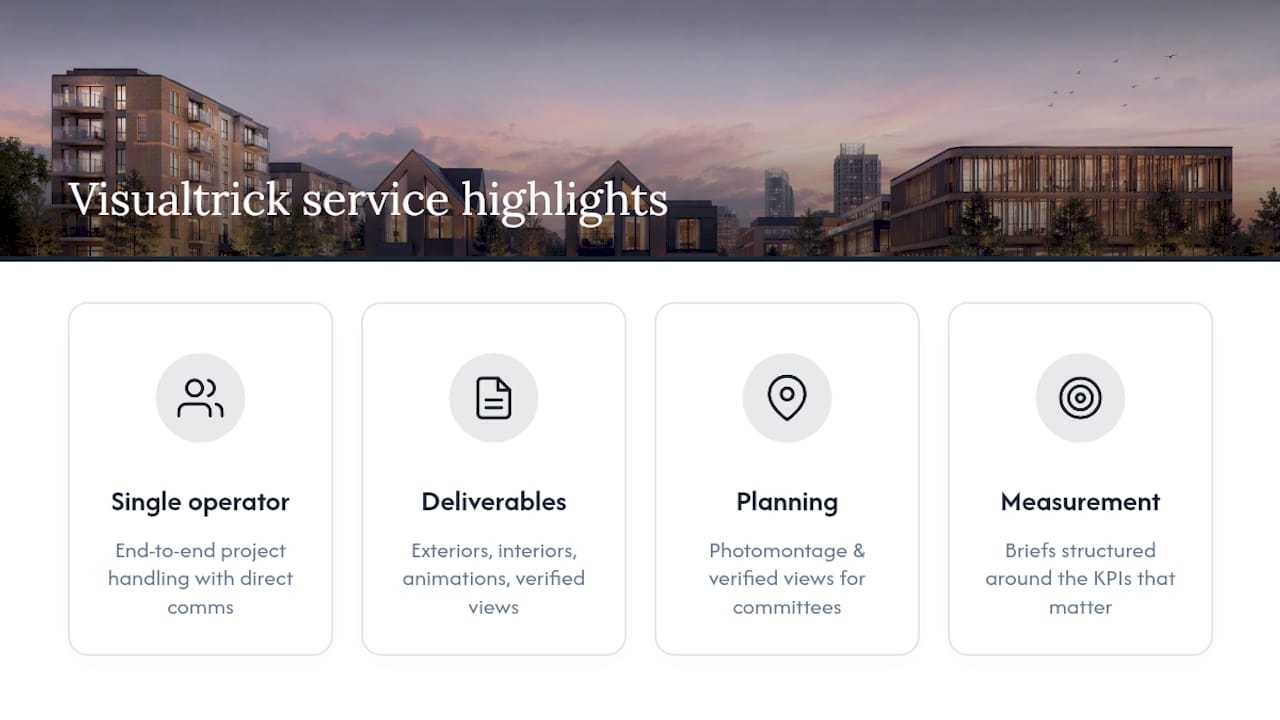
Visualtrick is the practical alternative to briefing a large agency for property CGI: one experienced operator handling your project end-to-end, with predictable deadlines and direct communication instead of a chain of account managers and subcontractors.
That matters most exactly where this article has focused: getting deliverables that map cleanly to funnel stages so you can actually measure what’s working. Visual Trick’s Architectural Visualisation, 3D Rendering, Planning Visuals and related services cover hero exteriors, key interiors, animations and verified views built for reuse across listing pages, brochures and planning submissions. The Property CGI service page has examples of the deliverable types discussed above, and if planning consent is part of your project, the planning visuals offering covers photomontage and verified views built to satisfy committee scrutiny.
If you’re commissioning your next phase, get in touch through the services page to discuss a brief structured around the KPIs that matter for your project.
Sources
For more on how CGI supports planning and marketing decisions, see the Kisiel Group’s overview of developer benefits. For background on how corporate ROI metrics like ROIC are defined and reported, CGI Inc.’s Q3 Fiscal 2026 results offer a useful, if unrelated, reference point for financial terminology.
- Benefits of CGI for property developers – Kisiel Group
- CGI reports third quarter Fiscal 2026 results
FAQ
What Counts as a Good ROI Percentage in Property?
There’s no single universal benchmark, since acceptable ROI varies heavily by asset class, region and risk profile. For marketing spend specifically, developers typically judge CGI ROI by whether incremental revenue from CGI-attributed sales clearly exceeds production and distribution cost, rather than chasing a fixed percentage target.
What Is CGI in Property Marketing?
CGI, short for computer-generated imagery, is photorealistic 3D visualisation used to show a property or development before it’s built or completed. It evolved from traditional architectural illustration and now covers everything from exterior renders to interactive 360 tours and planning photomontage.
What Does “ROI” Mean in Property?
ROI, or return on investment, measures the financial gain from an activity relative to its cost. In a property CGI context, that means comparing the revenue or sales velocity attributable to CGI assets against what those assets cost to produce and distribute.
How Do I Attribute a Sale Back to a CGI Asset?
Tag every campaign touchpoint with UTM parameters, route enquiries through a dedicated landing page for each major asset, and capture the enquiry source field in your CRM at first contact. Linking that source field through to the final reservation record is what makes attribution possible rather than guesswork.
How Long Does a CGI Project Take Before I See ROI Returns?
Production lead time for a full CGI package typically runs several weeks, and off-plan campaigns tend to see the bulk of their enquiries in the first six to eight weeks after launch. Planning-stage visuals pay back on a longer, less linear timeline, showing their value in faster committee decisions rather than immediate sales.
