
Architectural visualisation is defined as the process of creating accurate, photorealistic representations of unbuilt properties to support sales, planning, and investor communication. The role of visualisation in off-plan sales is to transform architectural drawings into images that buyers and investors can genuinely respond to. Properties marketed with high-quality visualisation can command sale price premiums of up to 9% and close deals 20%–31% faster than traditional marketing. That is not a marginal gain. It is a structural advantage that compounds across an entire development programme.
How does visualisation accelerate decisions in off-plan sales?
Buyers cannot walk through an unbuilt flat. They cannot feel the ceiling height, judge the natural light, or picture where their furniture sits. Visuals reduce the cognitive effort required to bridge that gap. When that effort drops, hesitation drops with it, and the path to reservation shortens.
75% of prospective buyers consider immersive visual content crucial when evaluating off-plan property. That figure reflects a shift in buyer expectation, not just buyer preference. Virtual tours increase the likelihood of a viewing by approximately 130% among buyers aged 18–34. That age group now represents a significant share of first-time and investment purchasers in the UK market.
“High-quality visuals act as a silent salesperson around the clock, attracting clients and accelerating sales even without physical presence or a sales team on hand.”
The psychological mechanism is straightforward. A photorealistic CGI render signals that the developer has invested in the project’s presentation. Investors read that investment as a proxy for construction discipline and project management quality. A developer who produces accurate, detailed visuals is perceived as one who will also deliver a finished building that matches the specification.
- Visuals reduce perceived risk by making the unbuilt feel tangible and credible.
- Accurate renders signal professional diligence, which experienced investors treat as a quality indicator.
- Immersive content shortens the sales cycle by reducing the number of follow-up questions and site visits required before reservation.
- Visual storytelling supports investor confidence in remote and international sales contexts, where physical visits are impractical.
Pro Tip: Commission your first round of CGI renders before your sales suite opens. Buyers who arrive without visuals available leave without reserving. Buyers who arrive with strong visuals reserve on the day.
What are the main types of visuals for off-plan property sales?
Off-plan property visuals fall into several distinct formats. Each serves a different purpose in the buyer journey, and the most effective developers deploy them as a coordinated set rather than in isolation.
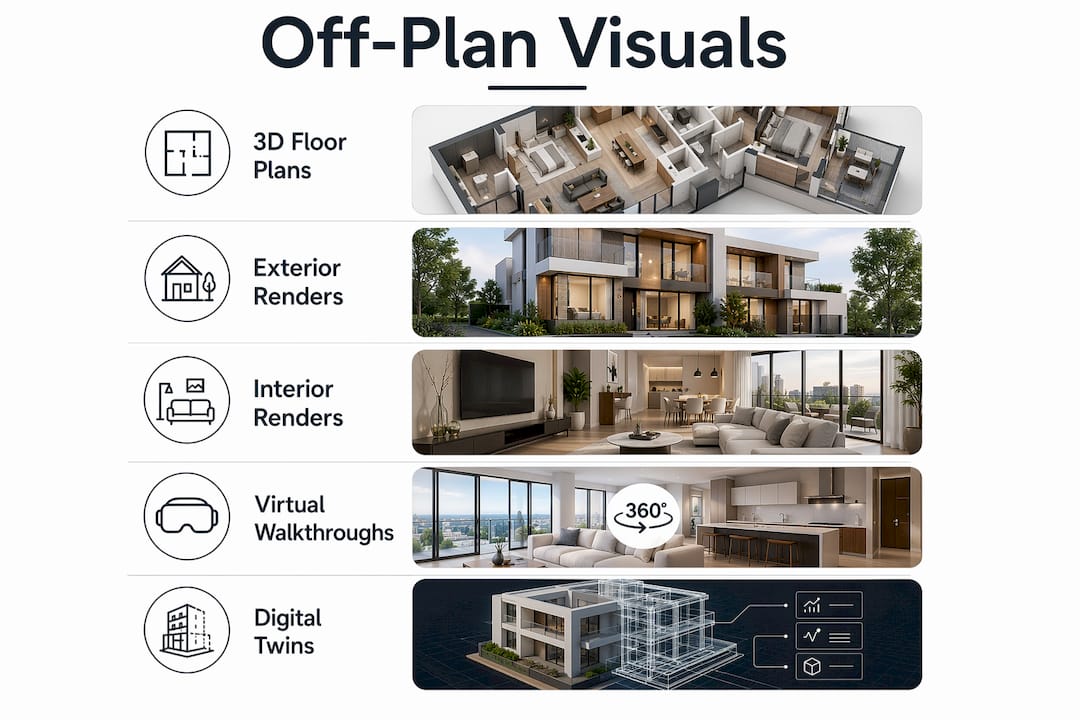
3D floor plans
3D floor plans are the baseline. They clarify scale, layout flow, and room usability in a way that a flat architectural drawing cannot. Buyers can immediately see whether a bedroom accommodates a double bed, whether a kitchen opens to a terrace, or whether a living space feels proportionate. The cost of producing 3D floor plans is lower than full exterior CGI, making them accessible at early project stages.
Photorealistic exterior and interior CGI
Photorealistic CGI renders showcase materials, lighting, and finishes with accuracy that flat drawings cannot achieve. A well-produced exterior render places the building in its real context, with accurate shadows, landscaping, and street-level perspective. Interior renders show the quality of specified finishes, the warmth of lighting schemes, and the spatial character of each room. These images carry the most weight in brochures, property portals, and investor presentations.
Virtual walkthroughs and interactive digital twins
Digital twins offer buyers a connected, explorable environment where they can move through a development at their own pace, compare units, and examine finishes interactively. Interactive 3D sales applications have helped increase consultation-to-reservation conversion by 18%. That improvement reflects the power of buyer agency: when investors can explore rather than be shown, their confidence in the purchase grows.
| Visual format | Primary benefit | Relative cost | Best deployment stage |
|---|---|---|---|
| 3D floor plans | Spatial clarity and layout understanding | Low | Early pre-sales |
| Photorealistic CGI | Material, finish, and character communication | Medium to high | Sales launch and marketing |
| Virtual walkthrough | Immersive exploration and unit comparison | High | Sales suite and remote investor presentations |
| Digital twin | Interactive unit selection and data integration | High | Full sales programme |
Pro Tip: Use visual content in marketing as a layered strategy. Start with 3D floor plans to establish spatial understanding, then introduce photorealistic renders to build desire, and deploy interactive walkthroughs to close hesitant buyers.
Why does visual consistency matter across sales channels?
Consistency across brochures, websites, and showrooms using coherent visual styles reduces buyer hesitation and cognitive friction. When a buyer sees one render in a brochure, a different style on the website, and a third interpretation in the sales suite, they lose confidence. The inconsistency signals that the developer’s own team does not share a unified vision of the finished product.
Experienced investors prioritise accuracy over aspirational visuals. A render that precisely matches the architectural specification builds confidence. A render that flatters the project with unrealistic proportions, impossible light conditions, or finishes that differ from the specification does the opposite. Investors who have purchased off-plan before recognise the gap between aspirational CGI and delivered reality. They discount developers who appear to be selling a dream rather than a building.
A unified visual language grounded in the actual architectural plans reinforces credibility at every touchpoint. The following practices maintain that consistency:
- Brief your CGI studio from the same architectural drawings that your contractor is building from. Any divergence between the two creates problems at handover.
- Agree a material and finish library before production begins. Every render should reference the same specified products, colours, and textures.
- Apply the same lighting philosophy across all assets. A warm, evening-lit interior render paired with a cold, overcast exterior render creates a jarring disconnect.
- Review all assets against the architectural specification before releasing them to market. A single inaccurate detail, spotted by a sharp investor, undermines the credibility of the entire suite.
- Update visuals when specifications change. Selling from outdated renders creates legal and reputational risk at completion.
Pro Tip: Treat your CGI brief as a legal document. The more precisely it specifies materials, dimensions, and finishes, the less room there is for misinterpretation, and the stronger your position if a buyer disputes the delivered product.
How to integrate visualisation into off-plan sales workflows
Early planning of visualisation production within development timelines avoids rushed, lower-quality outputs and supports a tiered asset strategy. Developers who commission visuals at the last minute receive assets that reflect the pressure they were produced under. The quality gap is visible, and buyers notice it.
Effective integration follows a clear sequence:
- Appoint your CGI studio at the same time as your marketing agency, not after. Both need the same architectural information, and their workflows should run in parallel.
- Produce 3D floor plans first. They are fast to deliver, low in cost, and give your sales team something to work with during the pre-launch period.
- Commission photorealistic exterior and interior renders once the specification is fixed. Changing finishes after render production means paying for revisions that could have been avoided.
- Plan your interactive or walkthrough assets for the sales launch itself. These take longer to produce and require the most detailed input from the design team.
- Use your visual assets in remote investor presentations from day one. International buyers and institutional investors make decisions based on visuals alone. A strong asset suite widens your addressable market without increasing your sales team headcount.
Integrating visualisation production early allows a tiered asset strategy from 3D floor plans to photorealistic renders, optimising budgets and timelines. The typical investment in visualisation sits at 0.3%–1% of gross development value. That cost is recovered many times over when the alternative is a slower sales cycle, a lower achieved price, or a failed launch.
Pro Tip: Build a visual asset checklist into your project programme at the planning stage. Assign ownership of each asset type to a named team member, and set delivery milestones that align with your sales launch date.
Key takeaways
High-quality architectural visualisation is the single most cost-effective tool available to off-plan developers for accelerating sales, increasing achieved prices, and building investor confidence before a brick is laid.
| Point | Details |
|---|---|
| Financial impact is measurable | Visualisation supports price premiums of up to 9% and sales cycles 20%–31% shorter than traditional marketing. |
| Accuracy builds investor trust | Renders that match the architectural specification signal professional discipline and reduce buyer doubt. |
| Visual formats serve different purposes | Deploy 3D floor plans, photorealistic CGI, and interactive walkthroughs as a coordinated set, not in isolation. |
| Consistency across channels is non-negotiable | Disjointed visuals across brochures, websites, and showrooms create cognitive friction that costs reservations. |
| Early commissioning protects quality | Appointing a CGI studio at the project outset prevents rushed outputs and supports a tiered asset strategy. |
Why I think most developers still underestimate visualisation
The developers I see getting the most from their visual assets share one habit: they treat CGI as a core project deliverable, not a marketing afterthought. They brief their CGI studio from the same drawings their architect is working from. They fix their specification before production starts. They plan their asset suite around their sales programme, not around what is left in the budget after everything else has been spent.
The developers who struggle treat visualisation as a box to tick. They commission renders too late, brief them too loosely, and then wonder why the assets do not convert. The renders look generic because the brief was generic. Buyers and investors can tell the difference between a render produced with care and one produced under pressure.
The market expectation for visual quality is higher than it has ever been. 3D floor plans are now a baseline essential for clear communication, not a premium add-on. Photorealistic CGI is the standard, not the exception. Interactive walkthroughs and digital twins are moving from differentiator to expectation, particularly among institutional investors and international buyers.
My honest view is that the 0.3%–1% of gross development value that visualisation costs is the best-spent line in any development budget. The return is not theoretical. It shows up in reservation rates, achieved prices, and the speed at which a scheme sells out. Developers who invest properly in their visual assets sell faster, at better prices, and with fewer buyer queries along the way. That is a straightforward commercial argument, and it gets stronger every year as buyer sophistication increases.
— Paride
Visualtrick’s architectural visualisation for off-plan sales
Off-plan sales demand visuals that are accurate, credible, and production-ready from the first day of marketing. Visualtrick produces high-quality CGI and 3D rendering services for property developers, architects, and estate agents across the UK and worldwide.
From 3D floor plans that clarify spatial layouts to photorealistic exterior and interior renders that showcase materials and finishes, every asset Visualtrick delivers is grounded in your actual architectural specification. For developers working on residential, retirement, or care schemes, Visualtrick’s architectural visualisation services support every stage of the sales and planning process. Contact Visualtrick to discuss your project and receive a tailored proposal.
FAQ
What is the role of visualisation in off-plan sales?
Visualisation turns architectural drawings into photorealistic images and interactive experiences that buyers and investors can evaluate before construction begins. It reduces perceived risk, accelerates decision-making, and supports higher achieved sale prices.
How do off-plan property visuals build investor confidence?
Accurate, detailed renders signal that a developer manages their project with discipline. Investors treat the quality of visual assets as a proxy for the quality of the finished building, which reduces hesitation and speeds reservation.
What types of visuals are used in off-plan property marketing?
The main formats are 3D floor plans, photorealistic exterior and interior CGI renders, virtual walkthroughs, and interactive digital twins. Each serves a different stage of the buyer journey and a different level of buyer engagement.
How much faster do properties sell with high-quality visualisation?
Properties marketed with high-quality visualisation close deals 20%–31% faster than those marketed with traditional methods, and can achieve sale price premiums of up to 9%.
When should a developer commission CGI for an off-plan scheme?
CGI production should begin at the same time as marketing planning, once the architectural specification is sufficiently fixed. Early commissioning supports a tiered asset strategy and prevents the quality loss that comes from rushed production.
