
If you need a UK architectural visualisation studio with planning-ready outputs, browser-based virtual tours and solid project management, Visualtrick is the strongest alternative to V-real. V-real is a north London studio with a long history serving large house builders, so the bar is high. Visualtrick matches it on planning outputs, adds web-based tour delivery, and covers projects from single planning stills through to multi-phase site-wide packages across the UK.
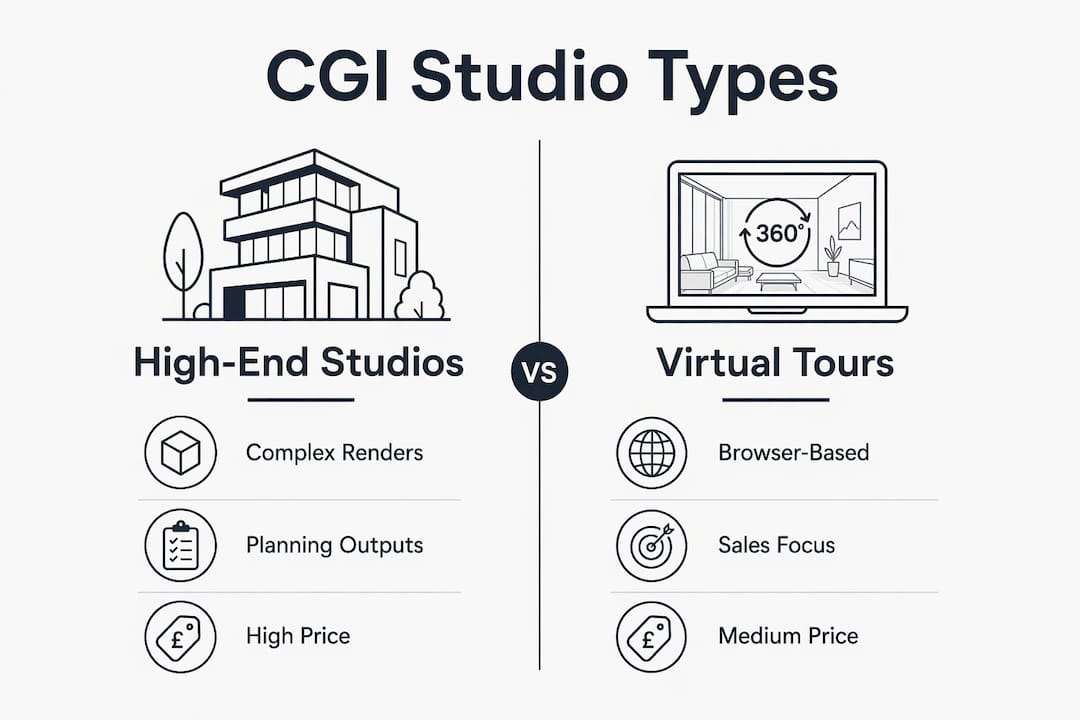
Beyond Visualtrick, the UK market splits into three useful provider types: high-end CGI studios for complex renders and animations, virtual-tour specialists for hosted 360° walkthroughs, and 3D scanning teams for measured surveys and point-cloud outputs. Which one you need depends on whether your priority is a planning committee, a sales suite, or a measured survey.
Table of Contents
- Which UK alternatives to V-real suit your project type?
- How do you choose between alternatives to V-real?
- What each service is and when you actually need it
- What does architectural CGI cost in the UK, and how long does it take?
- Managing large projects: browser-based platforms vs standalone files
- Why Visualtrick is recommended for UK projects
- What clients say about alternative UK studios
- Project examples: what quality and style variation looks like in practice
- Key takeaways
- The case for getting the brief right before you pick a supplier
- Get a quote from Visualtrick for your next project
- Selected sources and further reading
Which UK alternatives to V-real suit your project type?
The table below maps provider categories to project needs. Use it to shortlist before requesting quotes.
| Provider type | Best for | Services | Typical price band | Typical turnaround | Planning-ready outputs | Platform / asset management | UK scanning coverage |
|---|---|---|---|---|---|---|---|
| High-end CGI studio (e.g. Visualtrick) | House builders, architects, planners, care developers | Exterior/interior CGI, animations, virtual tours | £500–£1,500 per deliverable | 5–15 working days for stills; 3–6 weeks for animations | High-res TIFF/PNG, CAD overlays, OBJ/FBX | Browser-based hosted tours, CMS updates | Nationwide |
| Virtual-tour specialist | Estate agents, sales suites, marketing teams | 360° tours, hosted platforms, Google Street View | £300–£2,000 per tour | 2–5 working days | JPEG panoramas, GSV-formatted files | Hosted URL, branded delivery | Varies by provider |
| 3D scanning team | Measured surveys, refurbs, heritage projects | LiDAR/photogrammetry, point-clouds, OBJ/FBX | — | 48 hours to 2 weeks | OBJ, FBX, E57 point-clouds | Standalone files or viewer links | Often London-centric |
| Browser-based tour platform | Large developments, multi-phase sites | Tour organisation, library management, hotspot metadata | £33/month hosting upwards | Immediate on upload | Platform-dependent | Central library, multi-tour CMS | Platform-agnostic |
House builders and architects working on planning applications need the first category: high-res stills with CAD overlays and format-correct exports. Marketing teams launching off-plan sales benefit most from hosted virtual tours with a branded URL. For measured surveys on refurbishment or heritage work, a dedicated scanning team is the right call.
Visualtrick’s architectural visualisation service covers the first and second categories in one studio, which removes the coordination overhead of managing two separate suppliers.
How do you choose between alternatives to V-real?
Work through this checklist before you commit to any supplier.
- Planning-ready outputs confirmed in writing. Ask for examples of files submitted to planning authorities: high-res TIFF or PNG, CAD overlays, and OBJ/FBX exports. Marketing imagery alone is not sufficient.
- Technical formats listed in the quote. The deliverables schedule should name file formats explicitly, not just “renders” or “images.”
- Platform or asset management story for large projects. If you are managing a multi-phase development, ask how updates are handled. A browser-based CMS is far more practical than exchanging heavyweight files for every revision.
- Turnaround commitment in writing. Confirm whether quoted lead times include revision rounds.
- UK scanning availability. If you need on-site scanning, confirm the team operates in your region, not just Greater London.
- CAA compliance for drone work. Any aerial deliverable requires the supplier to hold a current Permission for Aerial Work from the Civil Aviation Authority. Ask for the certificate number, not just a verbal confirmation.
Questions worth emailing to any shortlisted supplier:
- What file formats are included as standard, and which cost extra?
- How are hosted tours updated when plans change?
- Do you hold a current CAA PFAW for commercial drone operations?
- What is your revision policy, and how many rounds are included?
- Can you share a planning application where your visuals were accepted?
Red flags to watch for: vague deliverables schedules that list only “CGI images,” no examples of planning-accepted assets in the portfolio, and no clear answer on how a large project’s assets are organised and updated over time.
What each service is and when you actually need it
Architectural CGI covers exterior and interior still renders, animations and fly-throughs. Still images are the standard deliverable for planning applications; animations suit investor presentations and off-plan marketing. Property CGI at planning grade requires accurate geometry, correct material specifications and sufficient resolution for committee-scale printing.
360° virtual tours and VR walkthroughs are the right choice for sales suites and off-plan marketing. A hosted tour lets buyers explore a scheme before it is built. Providers such as VRXS offer hosted platforms with optional Google Street View integration, which adds discoverability for property marketing. Platforms such as VRify focus on library organisation and multi-tour management for larger projects.
3D scanning and point-clouds serve measured surveys, refurbishment briefs and heritage recording. Outputs in OBJ, FBX or E57 format feed directly into BIM workflows. For London properties, some scanning providers can return assets within 48 hours of an on-site visit.
Pro Tip: Gaussian Splatting is worth asking about for web-based walkthroughs. The technique converts multi-view captures into a dense point-cloud renderable in real time inside a browser, giving a continuous walk-through feel rather than the jump-cut experience of discrete 360° panorama nodes. It runs via WebGPU/WebAssembly and is already being trialled in real-estate contexts. If photorealism and fluid navigation matter more than broad device compatibility, ask whether your supplier supports it.
What does architectural CGI cost in the UK, and how long does it take?
Prices vary considerably by scope, but these bands reflect the current UK market.
- Single exterior still: typically £500–£1,500 depending on complexity and number of revision rounds; turnaround 5–10 working days.
- Full interior set (3–5 views): typically £1,500–£4,000; allow 10–15 working days.
- Animation or fly-through: £3,000–£10,000+ for a 60–90 second sequence; lead times of 3–6 weeks are common.
- Site-wide visualisation package: bespoke pricing; multi-phase projects often run on retainer-style agreements with phased delivery.
- Virtual tour (360° hosted): £300–£2,000 for capture and setup; hosting from around £33/month for simple plans.
- 3D scanning visit: on-site sessions typically run 20–60 minutes for a single property, with assets deliverable within 48 hours for London locations.
Scope is the biggest cost driver. Adding custom material libraries, animated people, weather variations or a branded hosting platform each adds time and budget. Get a line-item quote rather than a single lump sum so you can see exactly what is and is not included.
Managing large projects: browser-based platforms vs standalone files
For a multi-phase development, exchanging standalone render files for every update is slow and error-prone. A browser-based tour and asset management platform solves this by keeping everything in one place.
Key benefits include a central asset library accessible to the whole team, zone and tour organisation across multiple phases, hotspot and metadata support for interactive content, and a branded delivery URL you can share with planners or investors without sending large files. Updates happen in the platform rather than requiring a developer rebuild.
Pro Tip: When requesting a supplier demo, ask specifically about the upload workflow, how tours are organised across zones, whether hotspot metadata is editable post-launch, and whether the platform supports Google Maps or Street View integration. Also confirm the file-format handover policy: for a multi-phase development you will want OBJ or FBX exports archived alongside the hosted tour so future teams are not locked into one supplier’s viewer.
Why Visualtrick is recommended for UK projects
Visualtrick serves house builders, architects, care and retirement developers, planners and interior designers across the UK. The studio’s output covers planning-ready stills, marketing CGI, and web-based virtual tours, which means a single supplier relationship covers the full project lifecycle from planning submission through to sales launch.
For planning work specifically, Visualtrick produces high-res outputs with the file formats and accuracy levels that local planning authorities expect. For care and retirement developers, the studio has a dedicated care home CGI track record, which matters when the brief involves sensitive context and stakeholder sign-off. Multi-phase projects benefit from the studio’s project management approach: phased delivery, clear revision schedules and a single point of contact rather than a rotating team.
What clients say about alternative UK studios
Client feedback on UK architectural visualisation studios consistently highlights three factors: accuracy of the final render against the approved drawings, responsiveness during revision rounds, and whether the files were accepted by the planning authority without amendment.
Studios that perform well in reviews tend to share a common trait: they ask detailed questions at the brief stage rather than working from a single drawing set. Clients on multi-phase schemes also value suppliers who maintain a consistent visual style across phases, so that imagery produced in year one still matches imagery produced two years later when the next phase launches.
Where reviews flag problems, the issues are usually the same: renders that look polished but contain geometry errors that planners query, slow turnaround on revisions, and hosted tours that break when the supplier’s platform changes. Asking for references from planning-stage projects specifically, rather than marketing projects, is the most reliable filter.
Project examples: what quality and style variation looks like in practice
Style variation between studios is more significant than most clients expect. Two studios working from the same drawing set can produce renders that look like different buildings, because lighting choices, material interpretation and context modelling all reflect the studio’s aesthetic preferences.
For planning work, photorealistic accuracy matters more than artistic style. A render that misrepresents the massing, materials or relationship to neighbouring buildings will draw objections. For marketing work, the opposite is sometimes true: a slightly aspirational treatment of landscaping and lighting can support sales without misleading buyers.
The practical implication is that you should request a sample render from your actual drawings, not just a portfolio review. A portfolio shows what a studio can do on its best projects; a sample from your brief shows whether the studio understands your specific context, constraints and audience.
Key takeaways
Visualtrick is the strongest single-supplier alternative to V-real for UK architectural CGI, virtual tours and planning-ready deliverables across house building, care development and architect-led projects.
| Point | Details |
|---|---|
| Confirm planning-ready formats | Ask for TIFF/PNG, CAD overlays and OBJ/FBX exports before signing any contract. |
| Check CAA compliance for drones | Require a current CAA PFAW certificate from any supplier offering aerial work. |
| Test the platform workflow | Request a live demo of how tours are updated and assets are organised for multi-phase projects. |
| Request a sample from your brief | A portfolio review is not enough; a sample render from your actual drawings reveals accuracy and style fit. |
| Visualtrick covers the full lifecycle | From planning stills to browser-based tours, Visualtrick handles CGI and virtual tours in one studio relationship. |
The case for getting the brief right before you pick a supplier
The most common mistake I see in this market is clients choosing a studio based on portfolio aesthetics and then discovering, mid-project, that the studio cannot produce planning-accepted file formats or has no answer for how a 200-unit scheme’s assets will be managed over three phases.
V-real’s longevity in the market reflects genuine capability. The studios worth considering as alternatives are those that can demonstrate the same rigour on deliverables, not just the same visual quality. A beautiful render that arrives in the wrong format, or a virtual tour that cannot be updated without a rebuild, costs more in the long run than a slightly higher upfront quote from a studio that has done this before.
The selection criteria in this article are not theoretical. Planning authorities do query file formats. CAA compliance for drone work is a legal requirement, not a nice-to-have. And for any project running beyond 12 months, the question of how assets are organised and updated is as important as the quality of the first batch of images.
Get a quote from Visualtrick for your next project
If you are evaluating v-real.co.uk alternatives for a planning application, off-plan sales campaign or multi-phase development, Visualtrick offers a practical starting point: a single planning still or a small pilot tour so you can assess quality and workflow before committing to a full package.
To get a useful quote quickly, prepare a short brief covering: project type (planning, marketing or both), number of views or scenes required, desired deliverables (stills, animation, virtual tour), your target submission or launch date, and a broad budget band. The more specific the brief, the more accurate the quote.
Visualtrick’s architectural visualisation services cover the full range from planning-grade stills through to browser-based virtual tours, with sector-specific experience in CGI for architects, care and retirement development, and property marketing. Contact Visualtrick to request a quote or discuss your brief.
Selected sources and further reading
- CAA: commercial drone operations and Permission for Aerial Work
- SJM Tech tests Gaussian Splatting for real estate (AMIN Worldwide)
- VBlank: next-generation virtual viewings and 3D scanning
- VRXS: hosted 360° virtual tours
- VRify: browser-based tour and library management
- V-real company information (Companies House)
- Visualtrick: architectural visualisation services
- Visualtrick: virtual tours
- Visualtrick: 3D rendering services
- Visualtrick: why architects use 3D visualisation
Recommended
- Best 3dlines.co.uk alternatives for UK property professionals | Visual Trick
- Architectural Visualisation & Property CGI Studio | UK, London & Kent | Visualtrick
- Architectural Visualisation & Property CGI Studio | UK, London & Kent | Visualtrick
- Architectural Visualisation & Property CGI Studio | UK, London & Kent | Visualtrick
