
An overseas CGI studio can work well for a UK project, but only if you control four things: a written brief, a contract under terms you can enforce, a paid test before you commit, and a change process with a named decision-maker. Price and portfolio come after those. Most problems on offshore visualisation jobs are not about the artist’s skill. They come from vague scope, unclear usage rights and feedback that drifts across time zones.
This guide is for developers, architects, planning consultants, estate agents and designers who are weighing up an overseas studio for property CGI, planning visuals or marketing images. It covers how to choose, what to put in the brief, what to agree in writing and how to keep the job moving.
TL;DR
- Judge a studio on a paid test render of your own project, not on a showreel. Agree the scope, deliverables and number of revision rounds before any work starts.
- Planning visuals and marketing images are different products. Keep verified views and photomontage separate from lifestyle CGI in the scope.
- Put governing law, payment currency, IP ownership, confidentiality and dispute resolution into the contract. Check data protection if the studio will see personal data.
- Run the job on fixed review windows, one consolidated feedback list per round and a written change log.
- Ask what you lose by going overseas: direct contact, predictable deadlines and accountability are what many UK clients end up paying for.
Table of Contents
- Why UK clients look overseas, and what it really costs
- How to choose an overseas CGI studio
- Write the brief before you ask for prices
- Agree the contract terms that matter overseas
- Manage the workflow across time zones
- Check quality and accuracy before you accept
- Red flags before you sign
- Our perspective
- Where we can help
- FAQ
- Sources
Why UK clients look overseas, and what it really costs
The pull is obvious: lower day rates, large teams and capacity for big batches of images. The cost is less visible. You take on distance, a different legal system, a language gap and, often, a production chain you cannot see. A studio that quotes you may pass the work to freelancers you never meet. That matters when a planning deadline is fixed and a single image is wrong.
None of this makes overseas work a bad choice. A large housing scheme needing dozens of exteriors may suit a bigger production team. A single planning submission with verified views, tight timing and a case officer reading the images may not. Decide which job you have before you compare quotes. Our guide to choosing a CGI studio sets out the criteria in more depth.
How to choose an overseas CGI studio
Ask who actually makes the images
The first question is simple: who will model, light and render your project, and will they be the person you speak to? Ask whether any stage is subcontracted. If the answer is yes, ask for the same terms to apply to the subcontractor, particularly confidentiality. Vague answers are an answer.
Match the portfolio to your use
A beautiful hero image for a sales brochure says little about whether the studio can produce a planning-ready photomontage from survey data. Ask for examples of the exact deliverable you need, and for a UK reference you can contact. For planning work, ask how they handle camera positions, site photography, survey control and the written method behind each view. Our page on planning visuals explains what verified views involve, and the guide to the role of visuals in planning permission shows where they sit in an application.
Pay for a test render
A paid test on a small, real piece of your project tells you more than any pitch. Use one interior or one exterior view, with your actual drawings, materials and a deadline. Judge it on accuracy against the drawings, how many questions the studio asked, how it handled your first round of comments and whether it delivered when it said it would. Our article on vetting overseas CGI with a paid test render and a signed SLA walks through this approach.
Compare quotes like for like
Two quotes are only comparable if they cover the same resolution, number of views, revision rounds, source file handling and licence. A low headline price with one revision round and no licence for print use is not cheaper. For a UK benchmark on what typical work costs, see our breakdown of property CGI costs in the UK.
Write the brief before you ask for prices
A good brief is what lets a remote team work without you in the room. The Design Business Association’s guidance says a brief should cover project background and objectives, audience, work already done, required services, measurable outcomes, budget, constraints, timeframe, approval process and contact details. For a CGI job, translate that into practical items:
- Purpose of each image. Planning, sales, investor pitch, tender or website. The purpose decides the level of accuracy and the viewpoint.
- Source material. CAD or BIM files, elevations, material schedules, landscape plans, site photographs and any survey data. State which drawing is the latest.
- Views list. A numbered list of every image with camera position, time of day and season.
- Deliverable specification. Pixel size, file formats, colour profile and whether you need print resolution.
- Approval chain. Who signs off, who can comment, and who has the final say when comments conflict.
- Timeline. Delivery dates for first draft, feedback and final, plus the hard external deadline such as a submission date.
- Budget and licence. What you intend to spend and where the images will be used.
If you work with a planning consultancy, our visualisation brief guide for planning consultancies and the 8-point pre-app CGI brief give ready structures. One warning applies to every brief. Clariva argues that poorly managed requirements are a leading cause of project failure and stresses naming stakeholders and approval chains up front. That is a company’s view rather than a study, but the practical point stands: a brief with three people giving contradictory comments produces expensive revisions.
Keep verified views and marketing CGI apart
This is the most common scope error. Verified views must be accurate representations tied to survey and site data. Marketing CGI is allowed to be atmospheric: warm light, furniture, people, sky. If both are in one line item, the studio may deliver the wrong standard for the wrong use. List them separately, as described in our guide to property CGI scope of work.
Agree the contract terms that matter overseas
Working across borders changes what a contract has to do. If something goes wrong, you may be pursuing a supplier in another country. LegalVision’s UK guide says an international supply agreement should specify price, delivery, quality, remedies, payment currency and timing, governing law, jurisdiction and dispute resolution. It also notes that arbitration can be a stronger route where the supplier’s country may not recognise an English court judgment. Take advice from a solicitor on the dispute clause for your particular country, because enforcement differs from place to place.
Payment and currency
State the currency in the contract and who bears exchange-rate movement and bank charges. Tie payments to milestones: a deposit at the start, a stage payment at approved drafts and the balance on final delivery. Avoid paying everything in advance to a studio you have not used before.

Changes, deadlines and cancellation
Write down what counts as a revision and what counts as a change of scope. A new building massing after the model is built is a change, not a revision. RICS change-control guidance says that changes should be registered, given a unique number, documented and reviewed for their effect on cost and programme, with a named person authorised to decide. Written for construction projects, the same discipline works for a CGI job. Add a short clause on what happens if the studio misses a delivery date, and on what you owe if you cancel part-way.
Intellectual property and image licence
Decide who owns what. The usual position for commissioned CGI is that you receive a licence to use the final images for named purposes, while the studio keeps its models and working files unless you buy them. If you need to reuse the 3D model for later phases or hand it to another team, say so now. UK government contract guidance points to the value of addressing supplier authority and rights, ownership of new intellectual property, licences for pre-existing intellectual property, third-party rights and confidentiality. Public-sector templates are not written for CGI, but the checklist transfers well. Government model contracts also make a point of defining Confidential Information and Intellectual Property Rights clearly, so the contractor’s methods do not give it ownership of yours.
For the property-specific detail, see our guides to CGI image licensing clauses and NDA clauses to protect source files.
Confidentiality and data protection
Unreleased schemes, investor material and client identities are commercially sensitive. Get an NDA signed before you send drawings, and ask where files are stored and who can access them. If you share personal data with the studio, such as resident details for a care scheme or site-visit images showing identifiable people, UK GDPR applies. The ICO says controllers must ensure restricted transfers of personal data comply with UK GDPR, including appropriate security measures. Its international data transfer agreement is one safeguard for sending data to a country outside the UK. Most CGI jobs need no personal data at all, and the simplest control is not to send any. If you must, talk to your data protection lead before the transfer.
Manage the workflow across time zones
Distance is manageable when the rhythm of the job is fixed. The rhythm, not the tools, is what stops things slipping.
Set review windows, not open-ended chat
GOV.UK’s agile contracting guidance describes iterative cycles with regular touchpoints, feedback, assessed iterations and reprioritisation. Borrow that structure. A typical CGI cycle looks like this:
| Stage | What you receive | What you do | Typical rule |
|---|---|---|---|
| Kick-off | Questions list | Answer in one document | One call, minutes sent in writing |
| Massing or grey model | Simple untextured views | Check geometry and camera angles | Geometry is locked after approval |
| Materials and lighting | Draft colour images | Send one consolidated comment list | One named reviewer collects comments |
| Final | High-resolution images | Check against drawings, approve | Final approval in writing |
Locking geometry before textures is the single best way to avoid paying twice for the same work. Changes to the building after that point go through the change log.
Handle time zones and language
- Agree a daily overlap window, even an hour, and keep it for questions.
- Send feedback as numbered points on marked-up images, not as long email paragraphs. Pictures translate better than prose.
- Use plain, literal wording for materials: give a product name or sample reference, not “warm stone-ish”.
- Ask for a written summary after every call, and correct it the same day.
- Name one contact on each side. Two project managers mean two versions of the truth.
When a studio is a day ahead or behind, a comment sent at 5pm in the UK may not be seen until your next morning. Plan the week so that critical feedback goes out early, and never leave sign-off to the final afternoon before a submission.
Check quality and accuracy before you accept
A CGI image can look excellent and still be wrong. Check it in two passes.
Pass one: accuracy. Overlay the image against your elevations. Count windows, floors and bays. Check the roof form, materials, boundary treatments, parking, levels and landscaping against the approved or proposed drawings. For planting, confirm species, size and maturity are realistic for the date shown, which our article on accurate planting visuals covers. Check that signage, furniture and vehicles are plausible and that nothing implies a feature you are not building.
Pass two: fitness for use. A planning image must be honest about the proposal. A marketing image can be styled, but should not mislead buyers about what is included. Check the resolution at the largest size you intend to print. For virtual staging in sales listings, read our guide to doing it honestly for estate agents.
Keep a checklist and apply it to every delivery. The property architect visualisation checklist is a good starting template.
Red flags before you sign
- No named person who will do the work, or a refusal to say whether work is subcontracted.
- A portfolio full of images with no drawings, no briefs and no explanation of purpose.
- A quote with no limit on revision rounds, or one that charges for every comment.
- No licence wording, or ownership terms that restrict your use of images you have paid for.
- Reluctance to run a paid test or to sign an NDA.
- Payment demanded in full before any draft is shown.
- Poor responsiveness during the quote stage. It will not improve after payment.
Our perspective
We produce all our imagery in-house, with a single experienced operator and no outsourcing. That shapes how we think about offshore work. Many clients who come to us have tried a distant production line first, and what they miss is not the rendering. It is being able to ask a question and get an answer from the person who built the model, and having a deadline that holds.

So our advice is practical. If your job is a large batch of marketing images, a distributed team may suit you, provided you insist on a test, a clear scope and a proper contract. If your job involves a planning submission, verified views, an investor deadline or a sensitive scheme, put direct communication and predictable delivery above the day rate. A cheaper image that must be redone, or that fails to match the drawings, costs more than the first quote suggested.
Whichever route you choose, write the brief first, separate the verified views from the marketing work, and decide who owns the files before the first render starts.
— Paride
Where we can help
If you want one contact, in-house production and a workflow built around your submission or sales date, our team handles architectural visualisation, 3D rendering and planning visuals for developers, architects, planning consultants, estate agents and designers. We can start with a small test view on your project so you can judge the work before committing to a full scope.
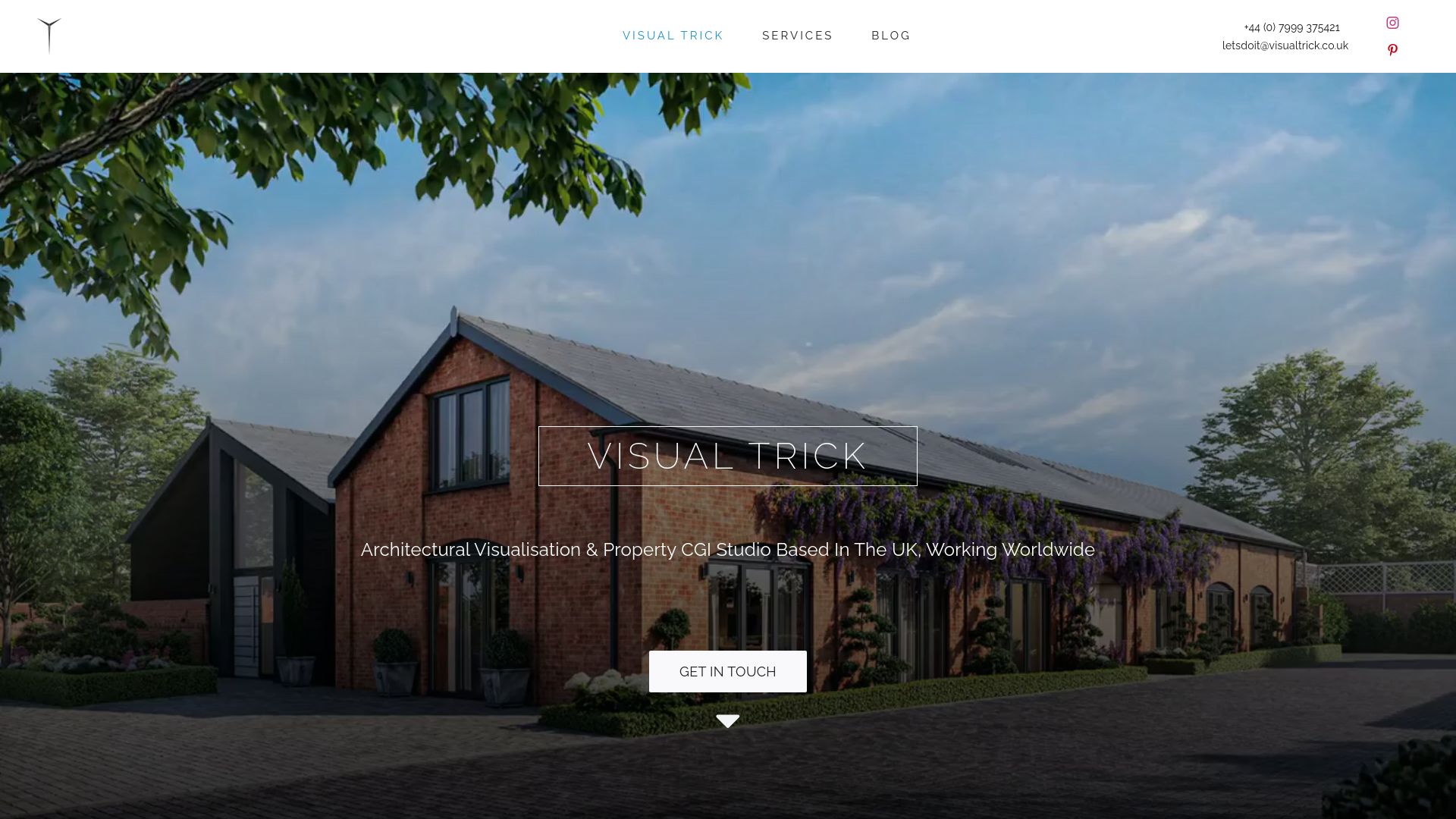
For planning work, see our CGI for planning applications page. For developers, look at CGI for developers. Pricing is project-based and depends on the scope, so send us your drawings and views list for a quote.
FAQ
Is it cheaper to use an overseas CGI studio?
The day rate often is, but the total cost depends on revisions, rework and your own management time. A quote that limits revisions and licence rights can end up costing more than a fuller UK quote. Compare scope, rounds of changes and usage rights before comparing the headline price.
Can overseas CGI be used in a UK planning application?
The location of the studio does not decide this; the accuracy and method of the images do. Ask your planning consultant what the local authority expects for views, then check that the studio can produce them from survey and site photography with a documented method. Our page on verified views explains what is involved.
Who owns the images and 3D model I pay for?
It depends entirely on the contract. Commonly you receive a licence for the final images for stated uses, and the studio keeps the working model unless you agree to buy it. State your intended uses, including reuse in later phases, in writing before work begins.
What should I do about data protection when sharing files abroad?
Send only what the job needs. Drawings and specifications rarely contain personal data, but site photographs or resident details can. If personal data must go to a country outside the UK, follow the ICO’s guidance on restricted transfers and speak to your data protection lead first.
How do I handle disputes with a studio in another country?
Set governing law, jurisdiction and the dispute route in the contract, and take legal advice on whether arbitration would be more enforceable than an English court judgment in that country. Milestone payments also limit your exposure if a job goes wrong.
Sources
- How to buy design: writing your design brief, Design Business Association
- How to Write a Project Brief for Agencies, Clariva
- Contracting for Agile guidance note, GOV.UK
- Change control and management, RICS
- International Supply Agreements: UK Business Guide, LegalVision
- International transfers webinar slides, ICO
- Draft international data transfer agreement, ICO
- Model contract, UK Government (Find a Tender)
- Short Form Contract comparison, GOV.UK
