
Commission planning‑ready photomontages and marketing CGI from a specialist visualisation studio early, ideally during RIBA stages 2 to 3 so committee packs and pre‑launch marketing both have accurate visuals ready when you need them. A build to rent scheme lives or dies on how convincingly it’s presented, both to planning officers and to the tenants who’ll sign before any flat exists.
What to brief in:
- Exterior renders and aerials for context and massing
- Internal apartment and communal space renders for marketing
- A verified photomontage where the site is visually sensitive
- Optional animation or virtual tours for off‑plan sales
Expect draft visuals within a few weeks and full budgets ranging from modest sums per still image to several thousand pounds for a verified photomontage package, depending on complexity and the number of unique views required.
Key Takeaways
Build to rent CGI succeeds when planning-ready photomontages and marketing renders share one base model, briefed early and reused across every stage of the scheme’s lifecycle.
| Point | Details |
|---|---|
| Commission early | Brief exterior and design‑stage visuals during RIBA stages 2 to 3, before design is locked. |
| Separate planning from marketing | Verified photomontages need surveyed camera data; marketing CGI is styled and staged freely. |
| Brief with real files | Supply current CAD/BIM exports, measured surveys and site photos to avoid delays. |
| Budget for reuse | Re‑using one base model across planning, investor and marketing outputs cuts overall cost. |
| Work with a specialist studio | Visual Trick builds planning‑ready and marketing CGI from the same model for UK build to rent schemes. |
Table of Contents
- Build to rent CGI: what it covers across planning, design and marketing
- When should you commission CGI for a build to rent scheme?
- How to brief a CGI studio for a build to rent project
- What’s the difference between planning photomontages and marketing CGI?
- What does build to rent CGI cost in the UK, and how long does it take?
- Why choose Visual Trick for build to rent CGI
- What do successful build to rent CGI projects actually look like?
- Who owns the CGI once it’s delivered, and what are the copyright rules?
- How does CGI fit with your other marketing tools?
- What most people get wrong about build to rent CGI
- Get a bespoke quote for your build to rent CGI
- Sources
Build to rent CGI: what it covers across planning, design and marketing
Build to rent CGI isn’t one product. It’s a family of outputs, each built to do a specific job at a specific stage, and treating them as interchangeable is where most procurement briefs go wrong.
- Design coordination uses working 3D models to check massing, materials and sightlines between design team members before anything goes to committee.
- Investor packs rely on polished exterior and aerial views that sell the scheme’s ambition to funding partners, alongside visualisation for joint venture proposals.
- Off‑plan marketing needs staged interiors, virtual showhomes and lifestyle dressing that a real, half‑built site simply can’t provide.
- Tenant prospecting and retention benefits from shareable social assets and virtual tours that keep a scheme visible for the 9 to 12 months before completion, which BTR marketing pipelines typically require.
Pro Tip: Ask your studio to build one base model and export both a verified photomontage and a dressed marketing render from it. You pay for the modelling once and get planning‑grade and sales‑grade outputs from the same geometry.
When should you commission CGI for a build to rent scheme?
Commission early conceptual visuals during RIBA stages 2 to 3, while design is still flexible enough that visuals can influence decisions rather than just record them. Save fully dressed showhome interiors and virtual tours for stages 4 to 5, once finishes and furniture layouts are locked and the images can stand in for photography that doesn’t exist yet.
Production typically runs through five stages:
- Brief and scoping — studio confirms deliverables, views and deadlines.
- Data collection — CAD, surveys and site photos are gathered and checked.
- Modelling — the base 3D model is built from your drawings.
- First draft — initial renders go out for review.
- Revisions and final delivery — agreed rounds of feedback are applied before sign‑off.
Most studios include two to three revision rounds in the quoted price. Extra rounds, late-stage design changes, or new camera angles requested after modelling is locked usually attract additional fees.
How to brief a CGI studio for a build to rent project
A vague brief is the single biggest cause of delay and cost overrun on visualisation projects. Studios can only price accurately and start modelling immediately when they have real, current data, not a placeholder set of drawings from three revisions ago.
Send these as a minimum:
- Up‑to‑date CAD or BIM exports (DWG, IFC or IFC‑compatible formats)
- A measured survey where the CGI must tie into an existing site or streetscape
- Site photographs from the proposed camera positions, including wide context shots
- A materials and finishes schedule, plus any landscape or hard‑surfacing layout
- 3D model exports in OBJ or FBX if you already have working geometry
For image specification, tell the studio your intended output: print resolution and aspect ratio for brochures, web‑optimised files for a marketing site, or wider format for hoardings. Specify a preferred lens equivalent (a 24 to 35mm feel reads as natural, wider distorts) and your preferred time of day and season, since golden‑hour renders suit marketing while flatter, neutral daylight is usually preferred for planning.
Pro Tip: Separate your brief into two clearly labelled sections: “planning‑ready” and “marketing”. This stops a verification workflow being accidentally applied to a lifestyle render, and vice versa, which is a common source of scope creep on mixed briefs.
What’s the difference between planning photomontages and marketing CGI?
A verified photomontage is technically controlled in a way marketing CGI simply isn’t. It uses a surveyed camera position, documented lens and focal length data, and a model placement checked against that survey, so a planning officer can trust the image shows exactly what the proposal would look like from that exact point. Marketing CGI has no such constraint. It’s built to sell a lifestyle, not to withstand scrutiny at committee.
Planning‑ready photomontage checklist:
- Surveyed camera point with recorded coordinates
- Documented lens and focal length
- Model placement verified against survey data
- A method statement explaining the verification process for the planning file
Marketing CGI, by contrast, typically features:
- Staged interiors with furniture, styling and warm lighting
- Idealised weather and time of day
- Lifestyle dressing (people, greenery in leaf, blue skies)
Pro Tip: Request your studio produce the verified planning view first from the base model, then adapt lighting and dressing for the marketing version. Building the verified version second, after creative liberties have crept into the model, usually costs more to unpick than it would to do it in the right order.
What does build to rent CGI cost in the UK, and how long does it take?
Prices vary enormously with complexity, but rough UK market bands give you a starting point for budgeting:
- Simple exterior stills: low hundreds to around £1,000 per image
- Interior showhome renders: similar range per room, higher with bespoke furniture modelling
- Verified planning photomontages: typically £1,500 to £4,000+ depending on survey requirements and number of viewpoints
- Animation and flythroughs: several thousand pounds, scaling with duration and complexity
- Full virtual tours: priced per unit or per showhome, often bundled with interior render packages
The main cost drivers are the number of unique views, whether verification methodology is required, how much bespoke modelling the scene needs, how tight the photo‑matching has to be, and whether you need rush delivery. Extra revision cycles beyond the agreed rounds also add cost.
To keep budgets sensible, re‑use base model geometry across planning and marketing outputs, batch similar renders together rather than commissioning them piecemeal, limit the number of genuinely unique interior layouts, and combine planning and marketing modelling into a single instruction wherever the timeline allows it.
Why choose Visual Trick for build to rent CGI
Visual Trick provides high‑end CGI, visualisation and 3D rendering for property developers, planners and architects, with direct experience producing planning‑ready visuals and marketing assets for UK schemes. That includes work with retirement and care developers, sector experience that translates directly into BTR schemes with communal amenities and regulated design requirements.
Service scope includes:
- External and internal stills for planning packs and marketing campaigns
- Verified photomontages built from measured survey data
- Animation, flythroughs and virtual showhomes for off‑plan sales
- Full BIM/CAD compatibility, working directly from your existing drawing set
Ask about typical turnaround, the revision policy included in your quote, and sample outputs from comparable schemes before committing. If you’re ready to move, Visual Trick’s property CGI service is the natural starting point for a bespoke estimate.
What do successful build to rent CGI projects actually look like?
The schemes that get the most value from CGI treat it as a marketing asset from day one, not a last‑minute planning requirement bolted on before submission. A well‑run build to rent launch builds a prospect database of 1,500 to 5,000 leads, 9 to 12 months before completion, and every one of those leads has usually seen a render, a virtual tour, or both, before they’ve seen a brick laid.
The strongest portfolios show a consistent pattern: one base model, reused across a planning committee pack, an investor deck, a teaser landing page, and a run of social ads, each with different dressing and framing but the same underlying geometry. That reuse is what keeps a scheme visually consistent across every touchpoint a prospective tenant encounters, from the first paid ad through to the sales suite screen.
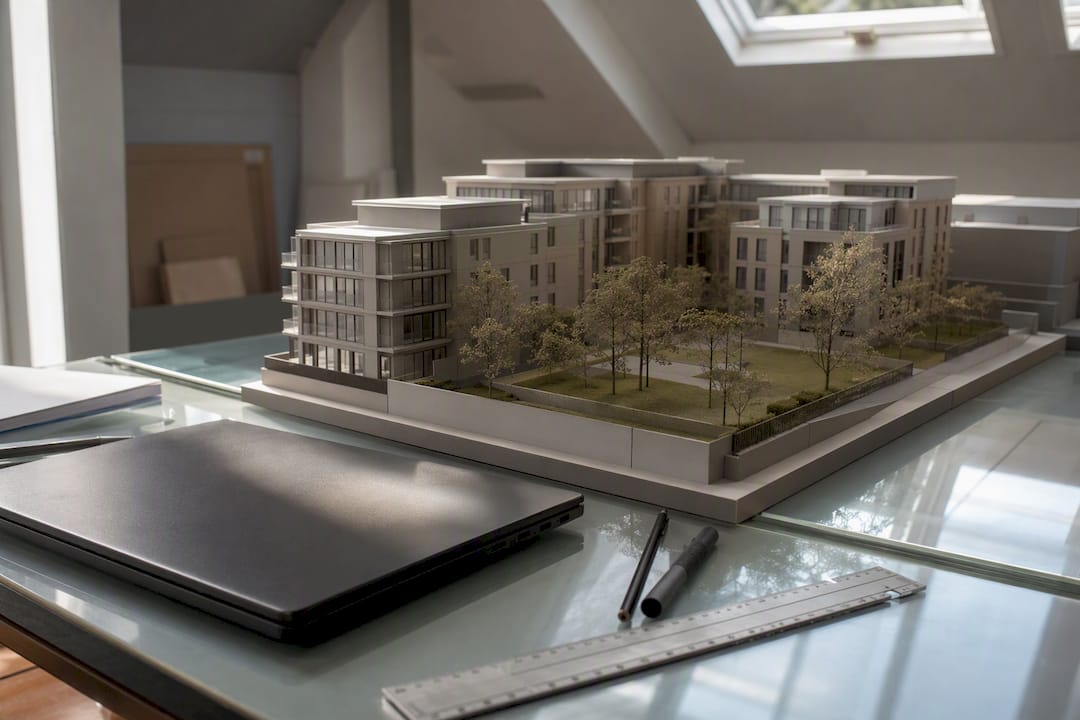
Interactive tools such as virtual showhomes and 360 tours have become a genuine differentiator for off‑plan BTR, letting tenants walk a flat that doesn’t physically exist yet and make a leasing decision with real confidence. Schemes that pair a virtual showhome with a live availability plan, showing which units are still open against a floorplate, tend to convert prospects faster than those relying on static brochure images alone. The lesson for anyone briefing a new scheme is straightforward: budget for a suite of assets that work together, not a single hero image.
Who owns the CGI once it’s delivered, and what are the copyright rules?
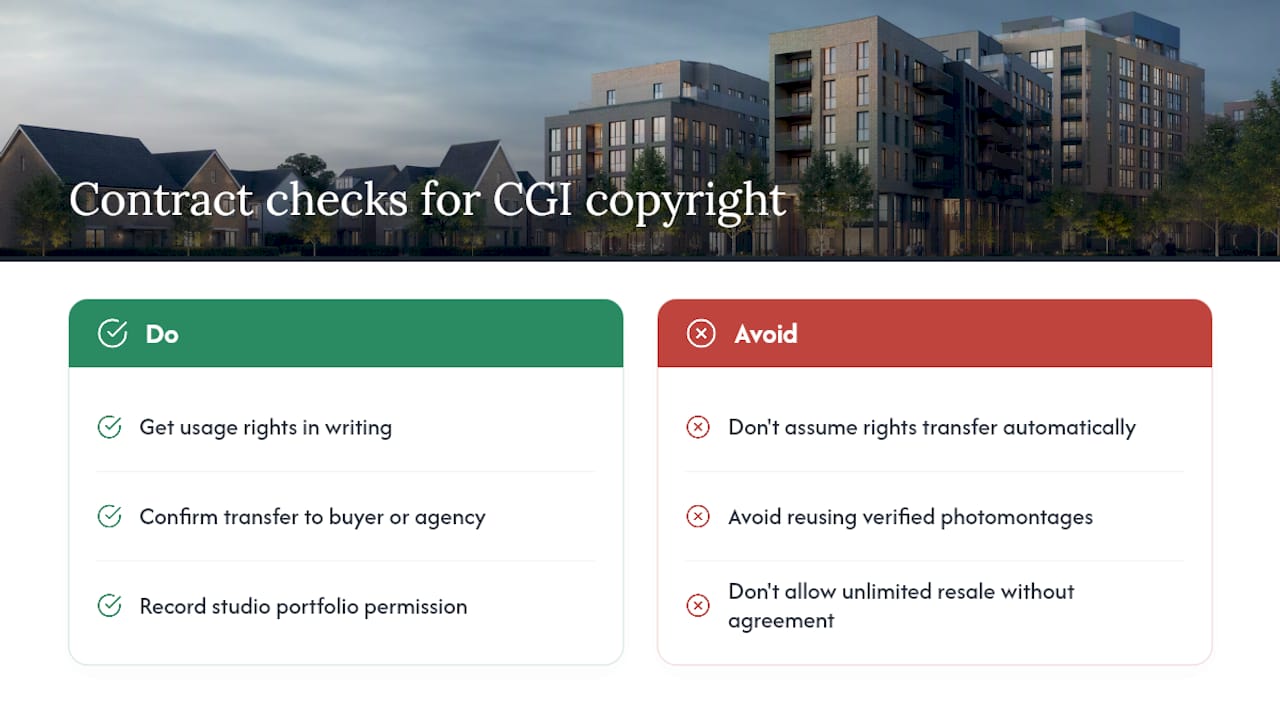
Copyright in a commissioned CGI image normally sits with the studio that created it unless your contract explicitly assigns those rights to you. This catches out more developers than you’d expect, particularly when a scheme changes marketing agency partway through a launch and the new agency assumes it can freely reuse existing renders.
Before you sign off a project, confirm three things in writing: what usage rights you’re buying (print, web, social, unlimited duration, or a fixed term), whether those rights transfer to a future buyer of the scheme or a new marketing agency, and whether the studio retains the right to use the work in its own portfolio. Most studios are happy to grant broad usage rights for marketing purposes, but unlimited resale or third‑party licensing usually needs a separate agreement.
Verified photomontages carry an added layer of care. Because they’re built from a real, surveyed viewpoint tied to your actual site, using an old verified view for a materially different scheme design, after the planning application has moved on, risks presenting inaccurate information to a planning authority. Treat verified photomontages as tied to the specific application they were produced for, and commission a fresh version if the design changes materially after submission.
How does CGI fit with your other marketing tools?
CGI works hardest when it isn’t sitting alone in a folder. Renders and virtual tours need to plug into the platforms your marketing team already runs, or they end up as one‑off assets nobody reuses.
The most useful integration point is a live availability system: linking a virtual showhome or interactive site plan to real unit data means a prospect can see which flats are actually still open while browsing a 3D render, rather than enquiring about a unit that let last week. Beyond that, high‑resolution renders should be exported in formats ready for your CRM’s landing pages, paid social campaigns, and any portal listings your leasing team uses, so nothing needs re‑exporting or re‑cropping every time a new channel picks it up.
Video and animation assets deserve the same treatment. A flythrough built for a planning committee presentation can usually be re‑cut for a YouTube pre‑roll or an Instagram Reel with minimal extra cost, provided you ask for that flexibility at the brief stage rather than after the animation is finalised. Building this into your initial studio brief, rather than treating each platform as a separate commission, is what actually saves money across a BTR marketing timeline.
What most people get wrong about build to rent CGI
The biggest mistake I see is treating CGI as a single line item bought once, near the end of the project, when the reality is it’s an ongoing pipeline that should start alongside planning and run through to lease‑up. Developers who wait until stage 5 to think about marketing visuals end up paying rush fees for work that could have been scheduled calmly two years earlier. Verified photomontages take longer to produce than people expect because the survey and methodology work happens before a single render is drawn, not after.
Get a bespoke quote for your build to rent CGI
Visual Trick is a practical alternative to briefing a generalist marketing agency and hoping they subcontract the visualisation properly. You get a studio that builds planning‑ready photomontages and marketing renders from the same working model, with direct BIM and CAD compatibility, so you’re not paying twice for two separate teams to model your scheme from scratch.
Whether you need a single verified view for a committee submission or a full suite of exterior, interior and virtual tour assets for an off‑plan launch, Visual Trick’s architectural visualisation service covers both ends of the brief. Send your CAD files, site photos and target dates through, and request a bespoke quote before your next planning deadline lands.
