
A single exterior CGI still typically runs from a few hundred pounds for a basic entry-level render up to a couple of thousand pounds for high-end, marketing-grade imagery, with mid-range studio work usually charging a moderate fee. Animation and masterplan sequences start higher, often beginning in the mid-thousands of pounds per shot. For planning submissions, choose the standard or high-end band; for early-stage feasibility work, entry-level pricing usually suffices. Every quote still depends on complexity, the number of views, and how the licence is structured.
TL;DR:
- Quoted prices usually exclude VAT and usage rights, which can significantly increase costs for extra licences or extended commercial use.
- The cost of exterior CGI starts at a few hundred pounds for basic images and can rise to several thousand pounds for high-end or animated sequences, depending on complexity.
- Supplying accurate CAD or BIM files, consolidating views, and limiting scope can reduce overall costs without compromising visual quality.
- A typical exterior still takes one to two weeks for completion, with full packages of five images requiring two to three weeks, depending on the project scope.
- Clear communication of plans, views, and deadlines accelerates accurate quoting and helps avoid unexpected charges or delays.
Table of Contents
- Exterior CGI cost bands: what each price point actually delivers
- What affects the price: the cost drivers studios actually charge for
- What a typical studio quote includes
- Itemised worked example: a small residential package (3 stills)
- How to reduce cost without cutting corners on quality
- Turnaround times and production milestones
- How Visualtrick scopes and prices exterior CGI projects
- Get an accurate exterior CGI quote
- Further reading
Exterior CGI cost bands: what each price point actually delivers
Exterior rendering prices split into four broad bands, and each one buys a genuinely different level of finish, not just a different price tag.
Entry-level single image typically covers a basic massing model built from limited reference material, generic materials, and flat daylight lighting. It’s suited to internal feasibility studies or early concept sketches where accuracy matters less than speed. Landscaping tends to be minimal or templated, and revisions are usually capped at one round.
Standard studio single image is where most property marketing and planning-support work sits. This band typically includes photoreal materials, considered lighting (often a specific time of day or season), basic landscaping and entourage such as cars or pedestrians, and one to two revision rounds. It’s the band most architectural visualisation studios build their default packages around.
High-end single image adds bespoke asset creation, such as custom vegetation matched to a real planting scheme, advanced atmospheric effects, and heavier post-production compositing. This is the tier developers commission for hero marketing shots, investor decks, or contentious planning applications where every detail needs to withstand scrutiny.
Animation and masterplan or aerial work starts from a higher base fee per shot and climbs steeply with duration and camera movement, because render time scales with every frame rather than a single still. A 30-second flythrough demands far more computational time than one photograph, which is why animation pricing rarely follows the same per-image logic as stills.
One point that trips up first-time buyers: quoted prices are almost always exclusive of VAT, and usage rights are frequently priced separately from the render itself. A standard commercial licence covering brochures and web use costs less than an exclusive or unlimited-use licence.
What affects the price: the cost drivers studios actually charge for
Every quote you receive is built from a handful of variables, and understanding them lets you brief smarter rather than just accept the first number.
- 3D model availability. If you supply accurate BIM or CAD files, the studio skips a large chunk of modelling work. Without them, the artist has to build geometry from drawings, photographs, or a site survey, which adds hours before any rendering even begins.
- Level of realism required. Procedural materials, custom HDRI lighting setups, and fine architectural detailing (brick coursing, window reveals, roof texture) all add time. A flat, generic render is quicker than one matched precisely to specified materials.
- Scope of the brief. More views, higher output resolution, and longer animation sequences all multiply cost, because each additional angle or frame needs its own render pass.
- Context complexity. Dense landscaping, neighbouring buildings, street furniture, vehicles, and human figures all need modelling or sourcing, and a busy urban context takes longer than an isolated rural plot.
- Post-production and bespoke assets. Custom compositing, sky replacement, colour grading, and building unique assets from scratch (rather than using a studio’s existing library) all add production hours.
- Scheduling. Rush jobs compressed into a few days typically carry a premium, since the studio has to reprioritise its render queue and staff time around your deadline.
Pro Tip: Send your 3D model, material references, and desired camera angles in the first email. A tight, well-organised brief reduces back-and-forth clarification and often shaves a meaningful chunk off the quoted modelling time, because the studio can price fixed work rather than guesswork.
What a typical studio quote includes
A properly scoped exterior CGI quote should spell out deliverables and rights clearly enough that nothing gets added as a surprise line item later.
Expect the following as standard:
- Final files in high-resolution formats suitable for print and web, sometimes with alternate crops or aspect ratios for different marketing channels.
- Source 3D files are rarely included in the base price. If you need them for future edits, ask upfront, since retaining them usually carries a separate fee.
- A structured review process: a whiteblock or wireframe stage to confirm camera angles and massing, a first full draft, then one or two included revision rounds before final sign-off.
- A standard commercial usage licence, covering brochures, websites and general marketing. Exclusive or unlimited-use rights, which prevent the studio reusing the model or scene elsewhere, cost more.
- Extras billed separately, including additional views beyond the agreed number, alternate material options, or extra animation frames.
Payment is typically staged: a deposit to secure the work and begin modelling, an interim payment at the draft stage, and a final balance on delivery. This structure protects both sides and keeps cash flow predictable on larger packages.
Itemised worked example: a small residential package (3 stills)
Seeing the line items laid out makes the pricing logic click in a way a single headline figure never quite does. Take a typical scenario: a small residential developer needs three exterior stills of a single house type for a sales brochure and web listing, with BIM data already available.
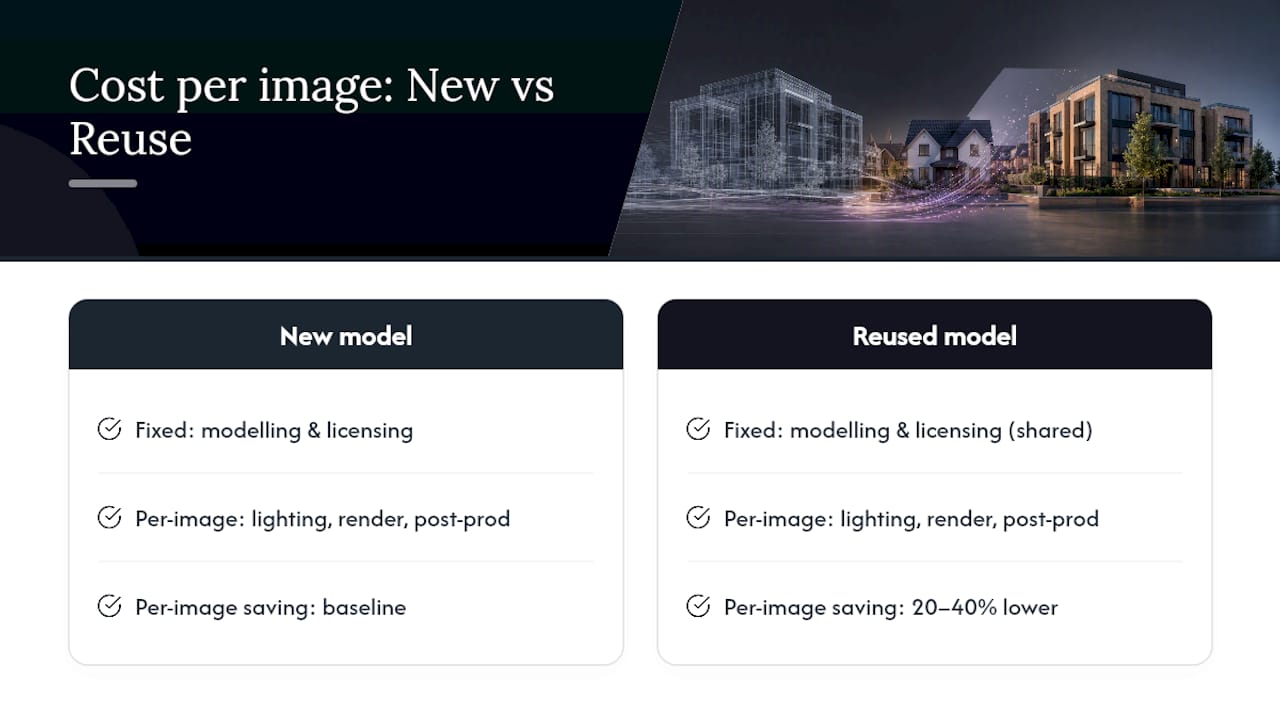
Modelling and licensing tend to stay relatively fixed regardless of how many views you request, while lighting, render time, and post-production scale roughly per image. That’s why a fourth or fifth view of the same house type, using the model already built, costs meaningfully less than the first three. Reusing a detailed model across multiple views and marketing assets can reduce per-image rendering cost by 20 to 40% compared with modelling each view from scratch, which matters enormously on multi-plot developments with repeated house types.
How to reduce cost without cutting corners on quality
Cost control on exterior CGI usually comes down to scope discipline rather than shopping for the cheapest studio.
- Supply CAD or BIM files. This single step removes the biggest variable cost in most quotes, since it eliminates hours of geometry reconstruction.
- Consolidate your views. Rather than commissioning eight near-identical angles, pick two or three that serve multiple purposes across the brochure, website, and planning submission.
- Use white-block visuals for early-stage marketing. A simplified, unrendered massing image can support initial sales enquiries before you commit to full photoreal work.
- Batch house types. If a scheme has repeated units, order renders for all of them together; studios frequently price repeat house types lower once the base model exists.
- Consider photomontage over full CGI. When a building already exists or a simple alteration is being shown, retouching a photograph can cost far less than modelling a scene from nothing.
Pro Tip: Ask your studio which two views would give you the most marketing mileage before you request a full set. A good studio will often talk you out of over-ordering, because a smaller, sharper package usually serves the brief just as well.
Turnaround times and production milestones
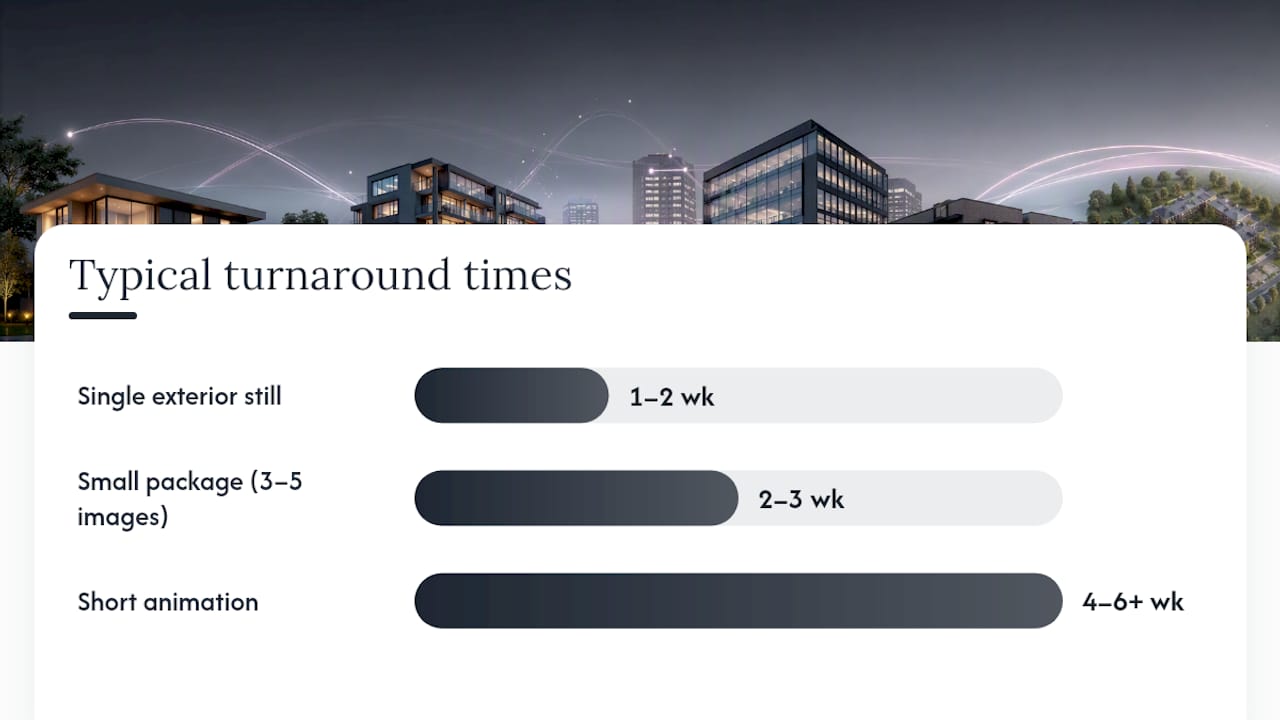
A single exterior still typically takes one to two weeks from brief confirmation to final delivery. A small package of three to five images usually needs two to three weeks, and short animations can run four to six weeks or longer depending on sequence length.
Most studios work to a consistent milestone structure:
- Wireframe or whiteblock review to confirm angles and massing before detailed work begins.
- First full draft with materials, lighting, and context in place.
- One or two revision rounds, agreed at quote stage.
- Final delivery in agreed file formats.
Slow client feedback is the single biggest schedule risk. If you supply your model and reference material promptly and turn revisions around within a day or two, you’ll keep the project on its original timeline. Rush delivery is usually possible but carries a premium, since it means reprioritising the studio’s render queue ahead of other work.
How Visualtrick scopes and prices exterior CGI projects
Visualtrick works with property developers, planning consultants, architects, and estate agents who need exterior CGI that holds up under planning scrutiny and performs in marketing at the same time. Getting a fast, accurate quote usually comes down to sending three things: your available drawings or model files, the views you want, and your deadline.
Visuals intended for a planning submission need a different level of accuracy than a sales brochure image, and that distinction shapes how a quote gets scoped from the outset. Following a structured visualisation checklist before you approach a studio, rather than after the first quote lands, tends to produce a tighter, more predictable price.
— Paride
Get an accurate exterior CGI quote
If you’ve read this far, you already know the honest answer is that no fixed number works for every scheme, but a clear brief gets you a tight, reliable quote fast. Prices for exterior CGI projects are determined based on actual drawings and views rather than generic packages, which helps avoid paying for guesswork built into blind quotes.
To get an accurate figure, send your available plans or BIM/CAD files, the specific views you need, and your target delivery date. That’s usually enough for a firm quote within a day or two. Visit the 3D rendering services page to see the full scope of what’s on offer and start a conversation about your project.
Further reading
For a deeper look at studio deliverables, see Visualtrick’s exterior CGI services page. On why accuracy affects pricing for submissions, read about the role of visuals in planning permission. For marketing context, see The Ultimate Guide to Real Estate Branding.
