
Pre-construction marketing visual examples are the tools developers use to present a development before a single brick is laid, combining photorealistic CGI, architectural scale models, and cinematic animation to generate sales and secure investment. The industry standard has shifted well beyond static floor plans. Developers who use integrated visual assets now sell units faster, attract stronger investor interest, and build brand recognition before groundworks begin. Techniques such as real-time 3D walkthroughs, exterior renderings, and lifestyle-driven animations each serve a distinct purpose in a well-structured pre-construction campaign.
1. What are the best pre-construction marketing visual examples?
Photorealistic architectural renderings are the foundation of every pre-construction marketing campaign. Interior and exterior CGI images bring a project to life before construction begins, giving buyers and investors a clear picture of the finished design, material palette, and spatial quality. Renderings support brochures, planning applications, digital advertising, and press coverage simultaneously.
- Exterior renderings show the building in context, including landscaping, street scene, and lighting conditions across different times of day.
- Interior renderings communicate lifestyle, finish quality, and spatial flow for individual unit types.
- Aerial CGI places the development within its wider neighbourhood, which is particularly persuasive for investors assessing location value.
Pro Tip: Commission both day and dusk exterior renders. The dusk version consistently outperforms in paid social advertising because warm lighting reads as aspirational rather than technical.
2. Cinematic animation as a storytelling tool
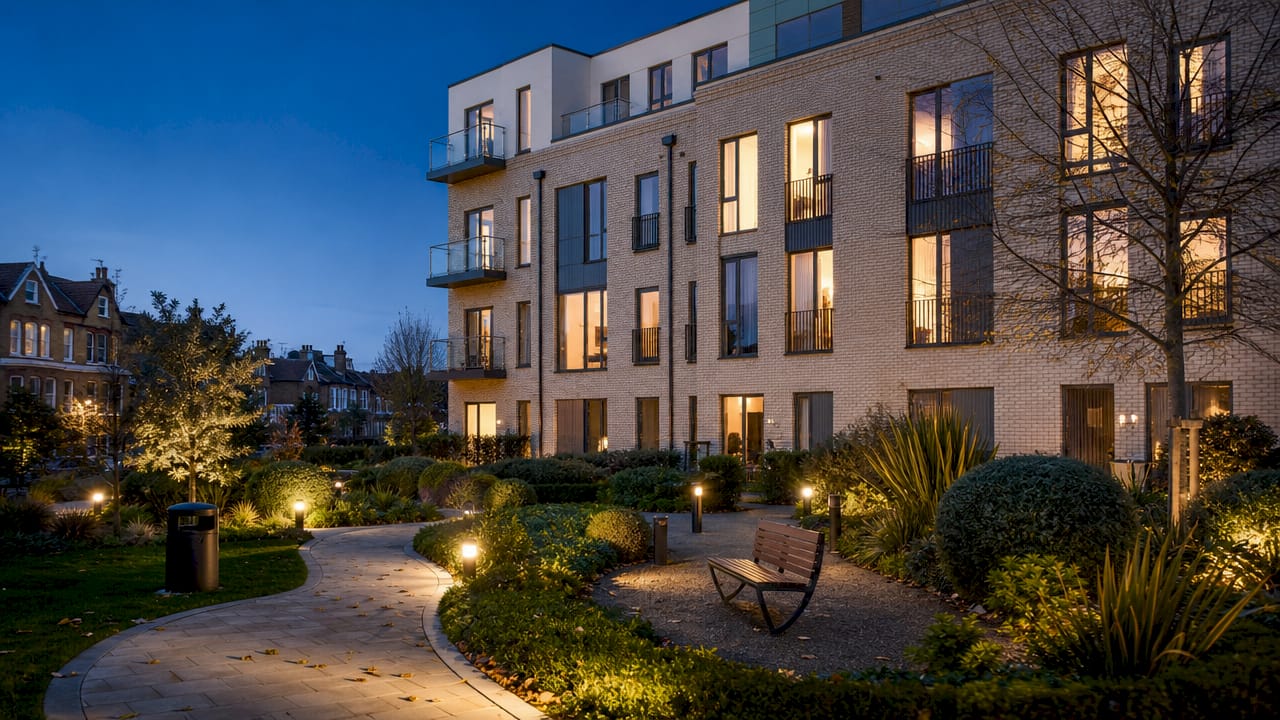
Cinematic animation translates architectural drawings into an emotional narrative. Where a still image shows a room, a well-produced animation shows a family arriving home, morning light moving across a kitchen, and a terrace at golden hour. Storytelling through animation is more persuasive in high-end property marketing because it connects the viewer to a lifestyle rather than a specification sheet.
For luxury pre-construction projects, cinematic animation combined with interactive 3D software is a high-impact construction marketing strategy. That combination gives sales teams a platform that works equally well in a physical gallery and on a developer’s website. The result is a consistent brand experience across every touchpoint in the sales process.
3. Interactive real-time 3D software platforms
Real-time 3D platforms allow prospective buyers to explore a development at their own pace, selecting unit types, floor levels, and finish options without waiting for a sales consultant to guide them. Real-time 3D sales software used in sales galleries paired with web access helps buyers explore developments intuitively, which produces stronger interest and more informed purchase decisions.
This format works particularly well in sales gallery environments where a large touchscreen display replaces the traditional printed site plan. Buyers can rotate the building, click into individual apartments, and view the corresponding interior rendering in seconds. The technology removes ambiguity and shortens the sales cycle.
Pro Tip: Ensure your real-time platform is also accessible via a web link sent after the gallery visit. Buyers rarely commit on the day. A link that lets them revisit the experience at home significantly increases conversion.
4. Architectural scale models
Physical scale models remain one of the most persuasive tools in pre-construction marketing, particularly for large mixed-use schemes and luxury residential developments. The best pre-construction marketing suites combine physical architectural scale models with interactive 3D software to provide clear project insight that surpasses static renderings alone.
A scale model gives visitors an immediate, tangible sense of massing, orientation, and relationship to surrounding buildings. It also photographs well for press coverage and investor presentations. The physical presence of a model in a sales suite signals confidence. It tells a buyer that the developer has invested seriously in the project before a single unit is sold.
5. Integrated visual marketing ecosystems
The most effective pre-construction campaigns do not rely on a single visual format. A cohesive marketing ecosystem incorporating a website, scale models, live 3D software, and renderings simplifies the sales process and strengthens brand recognition. Producing all assets from a single creative partner means visual consistency across every channel.
| Approach | Formats used | Buyer experience |
|---|---|---|
| Single format | Renderings only | Limited, static impression |
| Dual format | Renderings and animation | Stronger narrative, still passive |
| Integrated | CGI, animation, 3D software, scale model | Immersive, interactive, and memorable |
The integrated approach is not simply about having more assets. Each format addresses a different moment in the buyer’s decision process. Renderings create initial desire. Animation builds emotional connection. Interactive software answers practical questions. Scale models close the gap between imagination and reality.
6. Audience-specific visual marketing tactics
Different stakeholders respond to different visual formats. Tailoring your visual strategy to the audience is one of the most underused construction marketing strategies in the UK development sector.
For real estate investors:
- Aerial CGI showing proximity to transport links and commercial centres
- Development phasing diagrams illustrating project scale and return timeline
- Photorealistic exterior renders for investor decks and pitch documents
For prospective buyers:
- Interior lifestyle renders showing finished kitchens, bathrooms, and living spaces
- Cinematic animations featuring residents in the space, not just empty rooms
- Interactive 3D platforms allowing self-guided unit exploration
For sales and marketing teams:
- Real-time 3D software accessible on tablets for off-site appointments
- A library of pre-approved render crops sized for social media formats
- Animated GIFs derived from the cinematic animation for email campaigns
Visual posts on Facebook and Instagram are most effective for residential developers at a recommended frequency of 2–3 posts weekly. That cadence keeps a project visible throughout the pre-construction period without exhausting the audience.
7. Budget-conscious and emerging visual alternatives
Not every pre-construction campaign requires a full suite of bespoke assets. Budget-conscious alternatives such as VR, AR, and interactive website features offer immersive experiences without the costs traditionally associated with high-end physical models or full cinematic productions.
- Virtual reality (VR) headset experiences work well in sales gallery settings for high-value units where the cost of the hardware is justified by the sale price.
- Augmented reality (AR) apps allow buyers to point a phone at a site hoarding and see the finished building overlaid on the real location.
- Interactive website features such as clickable floor plans and unit availability maps extend the sales gallery experience to buyers who cannot visit in person.
- Drone footage of the site and surrounding area provides authentic context at relatively low cost and performs well on social media.
- Walkthrough animations produced from existing render assets offer a cost-effective alternative to full cinematic productions when budgets are constrained.
Video content and visual storytelling, including before-and-after walkthroughs and project progress updates, build greater trust and engagement than text alone. That trust is particularly valuable during the pre-construction period when buyers are committing to something they cannot yet see or touch.
Pro Tip: A simple time-lapse of site preparation, shared weekly on Instagram, costs almost nothing to produce and keeps your audience engaged throughout the construction period. It also builds credibility by showing real progress.
8. How visual content drives engagement across channels
Visual content generates significantly more engagement than text-based content across digital platforms. That principle applies directly to pre-construction property marketing, where the product does not yet exist and the visual asset is the only evidence a buyer has.
A well-produced exterior rendering placed in a targeted digital advertising campaign outperforms a text description every time. The same image repurposed across a brochure, a planning application, a press release, and a social media post multiplies the return on the original CGI investment. Developers who treat their visual assets as a catalogue of reusable content consistently extract more value from each commission.
Visual storytelling techniques that connect architectural design to a broader lifestyle narrative are particularly effective in competitive markets where multiple schemes are launching simultaneously. The development that tells the clearest story wins the buyer’s attention first.
Key takeaways
The most effective pre-construction marketing campaigns combine photorealistic CGI, cinematic animation, interactive 3D software, and physical scale models into a single, consistent visual ecosystem.
| Point | Details |
|---|---|
| Renderings are the foundation | Interior and exterior CGI support every channel from brochures to planning applications. |
| Integration outperforms single formats | Combining CGI, animation, and interactive software produces a more persuasive buyer experience. |
| Tailor visuals to the audience | Investors need context and scale; buyers need lifestyle and detail; sales teams need flexible, digital-first tools. |
| Budget alternatives exist | VR, AR, drone footage, and interactive web features deliver engagement at lower cost than full productions. |
| Consistency multiplies value | Assets produced from a single creative brief maintain brand coherence and reduce overall production cost. |
What I have learned about pre-construction visuals after years in the field
The developers who get the most from their visual marketing are not necessarily the ones with the largest budgets. They are the ones who treat their CGI and animation as a system rather than a collection of individual commissions.
I have seen projects where a single photorealistic exterior render was used across twelve different channels, from a planning application to a billboard to a LinkedIn post, and it performed well in every context because the quality was there from the start. The mistake I see repeatedly is commissioning visuals piecemeal, one render for the brochure, a separate animation for the website, a different style for the sales gallery. The result is a fragmented brand experience that undermines buyer confidence.
The other thing worth saying plainly: physical scale models are not obsolete. I know the conversation in the industry has moved heavily towards digital, and rightly so. But a well-made scale model in a sales suite does something that a screen cannot. It stops people. It creates a moment of genuine curiosity that no touchscreen has yet replicated. The developers who pair a quality model with real-time 3D software are consistently the ones whose sales galleries generate the strongest dwell time and the highest conversion rates.
The future of pre-construction visual marketing is not one format replacing another. It is the thoughtful combination of physical and digital touchpoints, each doing the job it does best.
— Paride
Visualtrick’s architectural visualisation for pre-construction campaigns
Visualtrick produces architectural visualisation services for property developers, architects, and marketing professionals across the UK and worldwide. The studio delivers photorealistic exterior and interior CGI, cinematic animations, and planning-ready visuals that support every stage of a pre-construction campaign, from investor pitch to public consultation.
Whether you are preparing a sales gallery, a planning application, or a digital advertising campaign, Visualtrick’s team works from your drawings to produce assets that are accurate, consistent, and built to perform across every channel. Developers working on residential, commercial, and specialist schemes can commission pre-construction CGI solutions tailored to their project scale and marketing timeline. Contact Visualtrick to discuss your next project.
FAQ
What are pre-construction marketing visuals?
Pre-construction marketing visuals are CGI images, animations, scale models, and interactive 3D platforms used to present a development before construction begins. They allow developers to sell units and attract investment based on the finished design rather than an empty site.
Which visual format is most effective for investor presentations?
Aerial CGI and photorealistic exterior renderings are most effective for investor presentations because they communicate scale, location context, and design quality at a glance. Cinematic animations add a lifestyle narrative that strengthens the investment case for residential schemes.
How does interactive 3D software improve pre-construction sales?
Real-time 3D software allows buyers to explore unit layouts, floor levels, and finish options independently, which produces more informed decisions and shorter sales cycles. It works in sales galleries and via web links sent after appointments.
Are VR and AR cost-effective for smaller developments?
VR and AR are most cost-effective when the unit sale price justifies the hardware investment, typically for high-value or luxury schemes. For smaller developments, interactive website features and drone footage deliver strong engagement at a fraction of the cost.
How many visual formats should a pre-construction campaign include?
A well-structured campaign uses at least three formats: photorealistic renderings for print and digital advertising, a cinematic animation for the website and social media, and an interactive platform or scale model for the sales gallery. Each format addresses a different stage of the buyer’s decision process.
